When Solatube Home launched their referral program, they weren't just hoping satisfied customers would spread the word—they already knew it was happening. Homeowners were recommending the brand to friends and neighbors after every installation. The problem wasn't enthusiasm; it was invisibility. There was no way to track who was referring, no way to reward advocates fairly, and no way to turn a trickle of informal recommendations into a reliable growth channel.
Since partnering with ReferralHero, that has changed. Since launch, Solatube Home has generated $49,749.53 in revenue from referral-driven installations, with a 75% appointment-to-installation conversion rate—nearly double the industry average for home improvement leads. A total of 225 referred homeowners have visited the site through shared referral links, with 19.1% converting to quote requests compared to the 2-5% industry average for cold traffic. Across three markets—Texas, California and Arizona—word-of-mouth is no longer invisible. It is measurable, rewarded, and growing every month.
This case study breaks down exactly how Solatube Home built that system: the incentive structure, the participant flow, the launch strategy, the ongoing promotion tactics, and the results that validated every decision along the way.
The Challenge: Great Customer Relationships, No Way to Scale Them
Solatube Home had something most businesses work hard to earn: genuinely satisfied customers. Strong reviews, repeat engagement, and organic recommendations were already part of the business. But organic goodwill, left unstructured, doesn't compound. It leaks.
Before launching their referral program, three interconnected problems held Solatube Home back:
- No tracking. Referrals happened informally, but there was no visibility into who was referring, how many leads it generated, or which customers were the strongest advocates. Revenue was being driven by word-of-mouth that left no paper trail.
- The wrong incentive. A previous referral attempt offered $50 off a customer's next installation. On paper it seemed reasonable. In practice, it failed to resonate—customers who had just completed a project weren't thinking about their next one. The incentive was solving the wrong problem at the wrong time.
- One-and-done outreach. A single email after installation was the extent of the program's promotion. With no follow-up, no reminders, and no dashboard for advocates to track their activity, most customers forgot about it before they had a chance to act.
"We didn't have a way to track our referrals before & it wasn't an offer that we felt appealed to customers. Now, we have a system automated for us that reaches out to customers automatically after they install with us. Customers are happy with the $100 we're offering now instead of $50 off their next installation."
— Solatube Home Team
The goal wasn't to overhaul how customers talked about Solatube Home—it was to build a structure around what was already working and make it visible, trackable, and rewarding for everyone involved.
The Solution: Formalizing Advocacy Without Complicating It
Solatube Home's referral program was built on a simple premise: if customers were already recommending the brand, the job wasn't to manufacture new behavior—it was to support the behavior that already existed and give customers a reason to do it consistently.
That meant designing a program with low friction for advocates, meaningful rewards tied to real outcomes, and enough automation that the system could run without demanding constant manual effort from the Solatube Home team.
Referral Program Rewards
The reward structure was designed to be simple enough for any customer to understand immediately and compelling enough to motivate action. Both sides of the referral relationship are rewarded—but only when a real installation happens:
- Referred customers receive $100 off their first Solatube Home installation when they sign up for an estimate, giving them a concrete reason to move forward.
- Advocates earn a $100 reward once their referred customer completes their first installation, ensuring rewards reflect genuine, qualified referrals rather than low-intent leads.
Tying rewards to completed installations rather than early-stage interest was a deliberate decision that distinguishes Solatube Home's program from referral programs that reward volume over quality.
Why a $100 Flat Rate?
The choice of a flat $100 reward rather than a percentage-based incentive came down to business math and customer psychology. Installation values vary significantly across Solatube Home's service areas and project types, making a percentage structure unpredictable. A flat rate eliminates ambiguity for advocates and keeps the reward easy to communicate in a single sentence.
"We chose a flat rate of $100 because every installation has a different ticket value. Also, we typically spend around $80 on average for a lead & these leads are more valuable and more likely to turn, so we chose that amount."
— Solatube Home Team
At $100 per completed referral, the cost per acquisition through the program is comparable to traditional advertising—but with a significantly higher conversion rate and a pre-qualified buyer who already trusts the brand before the first conversation.
How the Referral Program Works: Participant Flow
The program was designed to mirror how homeowners naturally recommend contractors—through personal channels, at the right moment, with minimal effort required. Each step builds on the previous one to move advocates and referrals through a clear, rewarded journey.
Step 1: Automatic Enrollment After Installation
Rather than asking customers to opt into a separate program, Solatube Home automatically enrolls advocates after their installation is complete. This captures customers at the moment when satisfaction is highest and the memory of a great experience is freshest. Installers and staff reinforce the program in person during this window, ensuring customers hear about it directly from the people who just completed their project.
Step 2: Advocate Dashboard Access
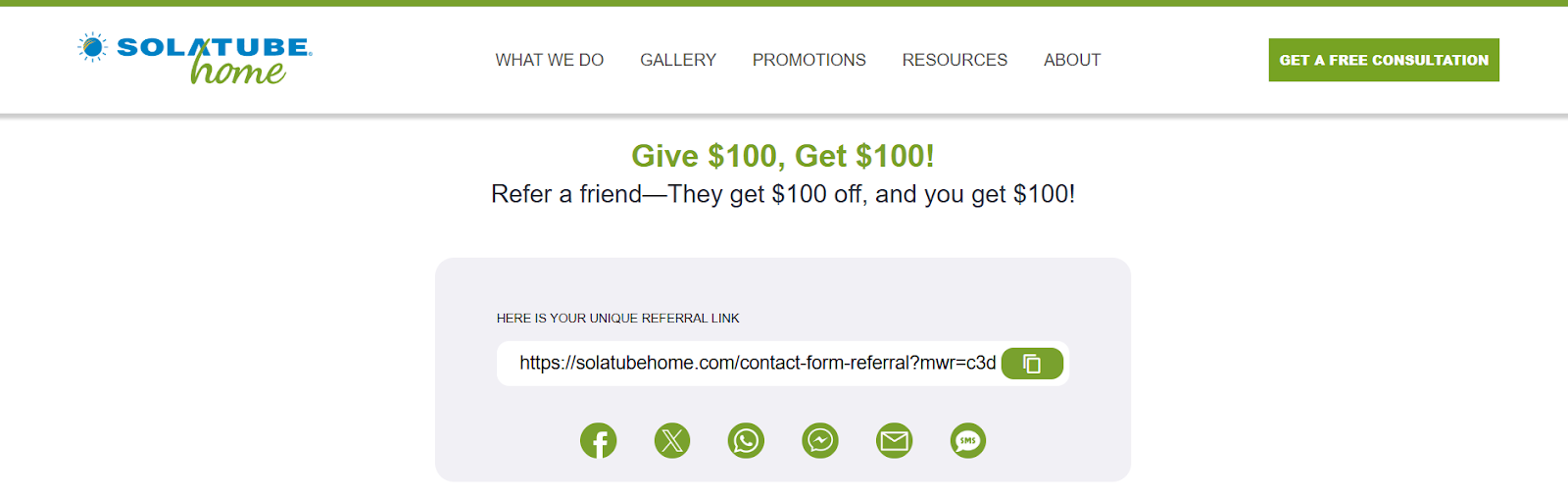
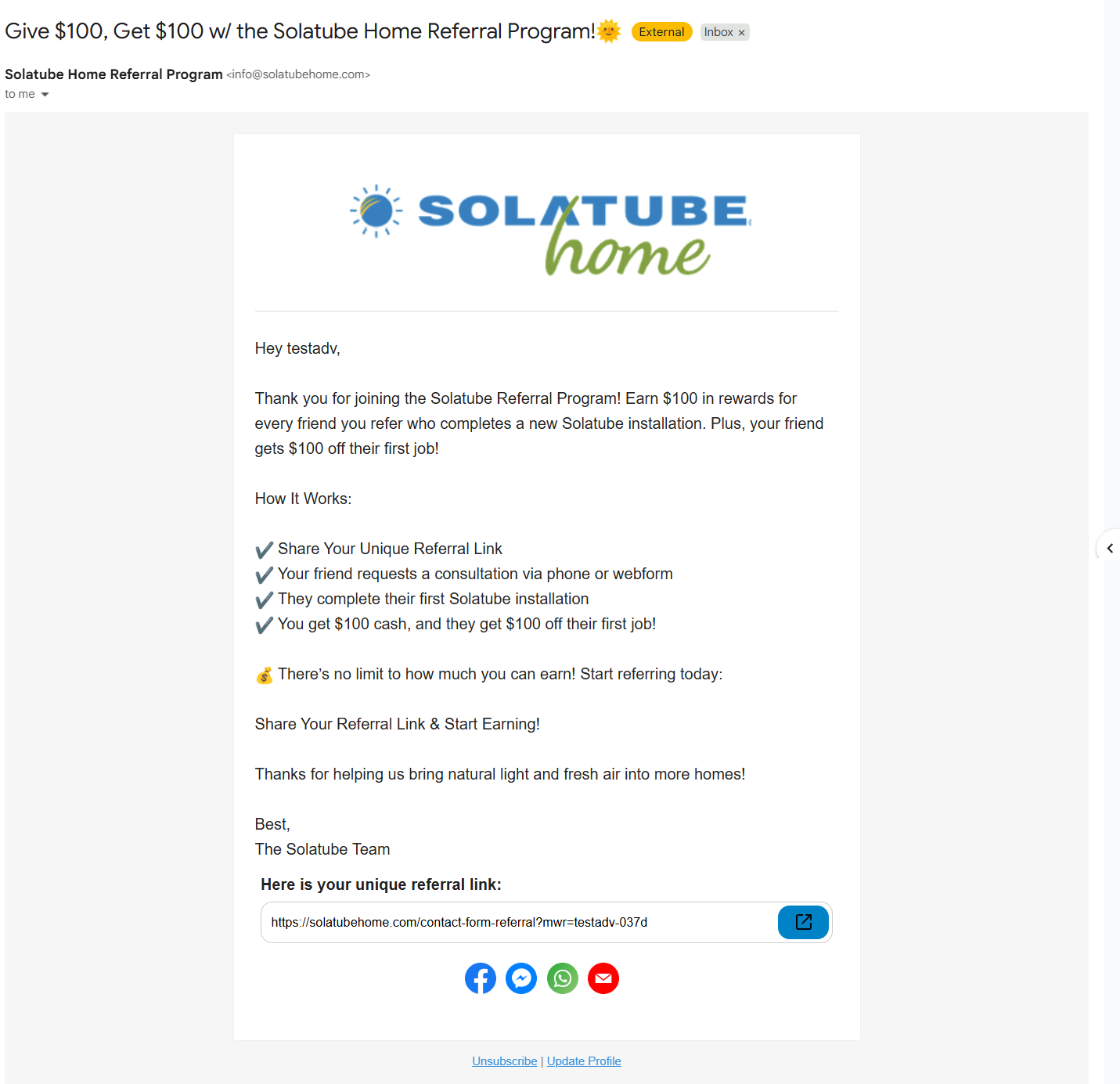
Enrolled advocates receive a welcome email and SMS with their personal referral link and access to a referral dashboard on the Solatube Home website. The dashboard lets advocates track shares, monitor referral activity, and check reward status—giving them visibility and a reason to stay engaged with the program over time.
Step 3: Sharing Across Multiple Channels
The referral link can be shared via text message, email, WhatsApp, Facebook, X, or Messenger—matching the channels homeowners already use. Rather than forcing advocates into a new behavior, the program inserts itself into existing communication habits, reducing the friction between intention and action.
Step 4: Referred Homeowner Clicks the Link
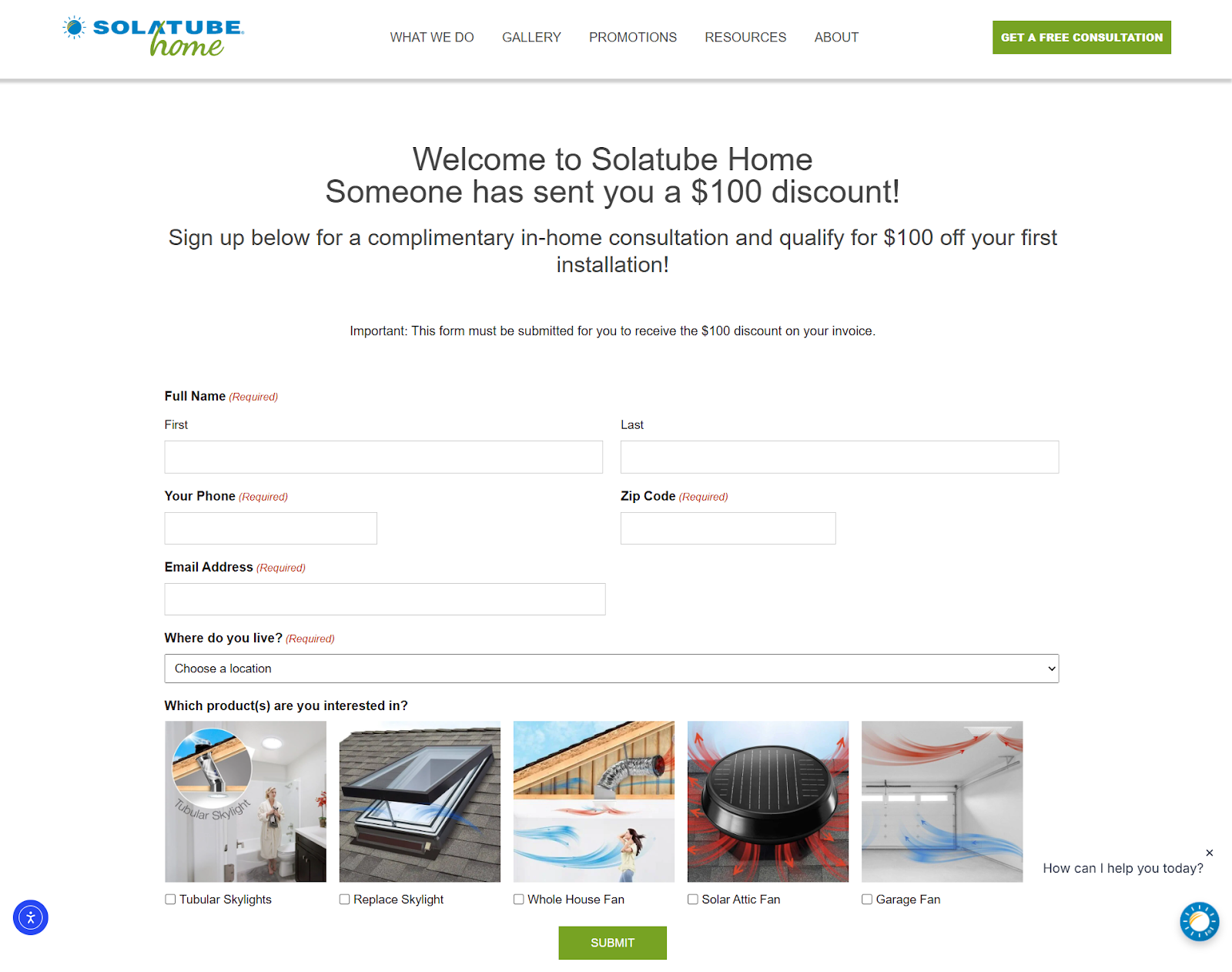
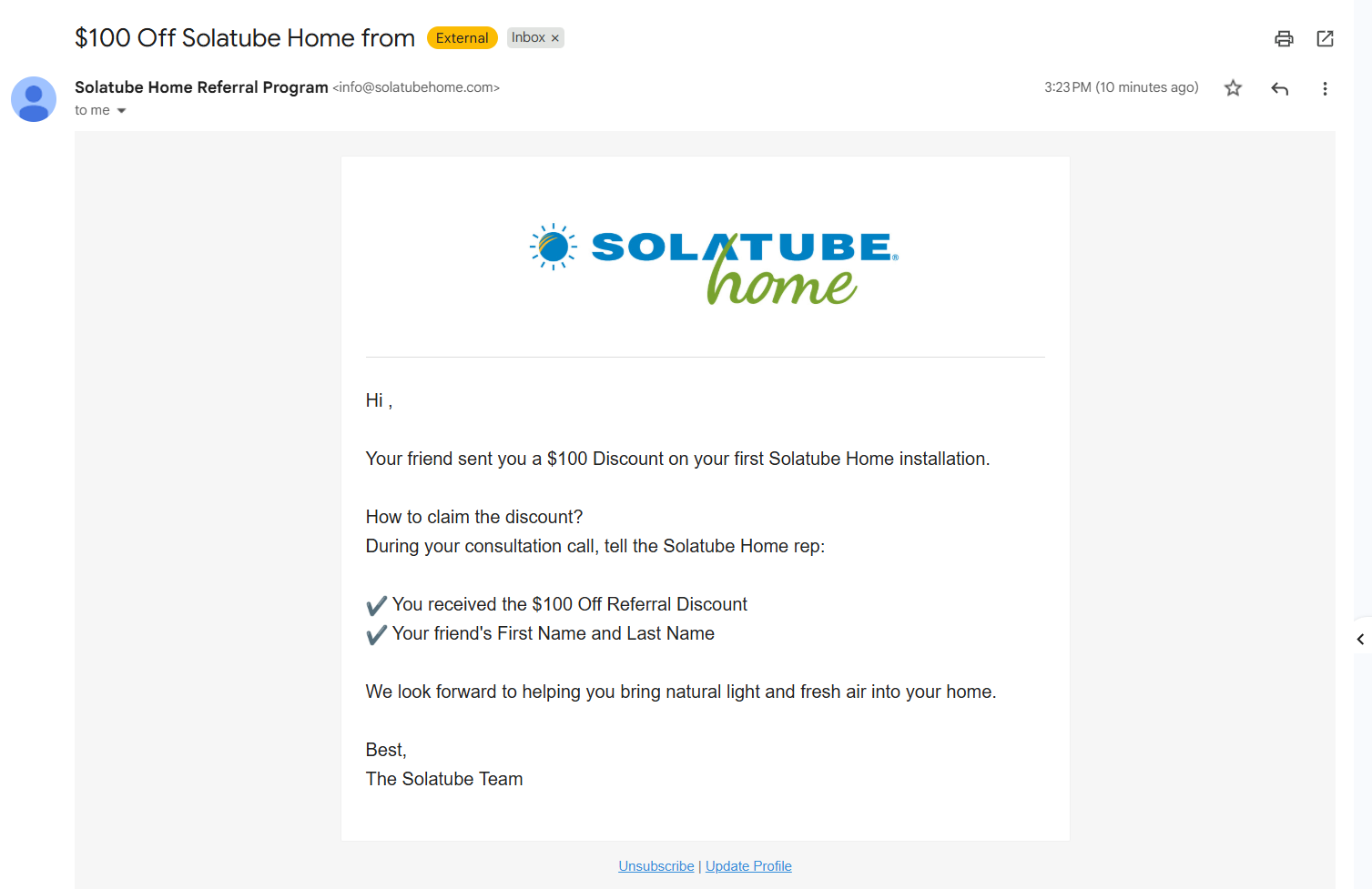
Referred homeowners land on a dedicated page that clearly communicates the $100 discount and prompts them to schedule a complimentary in-home consultation. For customers who prefer to call rather than complete an online form, the program accommodates phone referrals by allowing them to mention the advocate's name—ensuring accurate attribution regardless of how they choose to engage.
Step 5: Referral Requests a Quote
When a referred homeowner submits an estimate request—online or by phone—they are recorded in the referral system. A confirmation email and SMS notify them of their $100 discount, reinforcing commitment and setting expectations before the appointment. This step is the first conversion event and is where Solatube Home sees a 19.1% visitor-to-quote conversion rate, far exceeding the 2-5% industry average for cold traffic.
Step 6: Installation is Completed
Once the referred customer completes their installation, the referral conversion is confirmed. Tying this step to completion—rather than just scheduling—keeps the program grounded in real business outcomes and ensures every tracked conversion represents actual revenue.
Step 7: Advocate Receives Their Reward
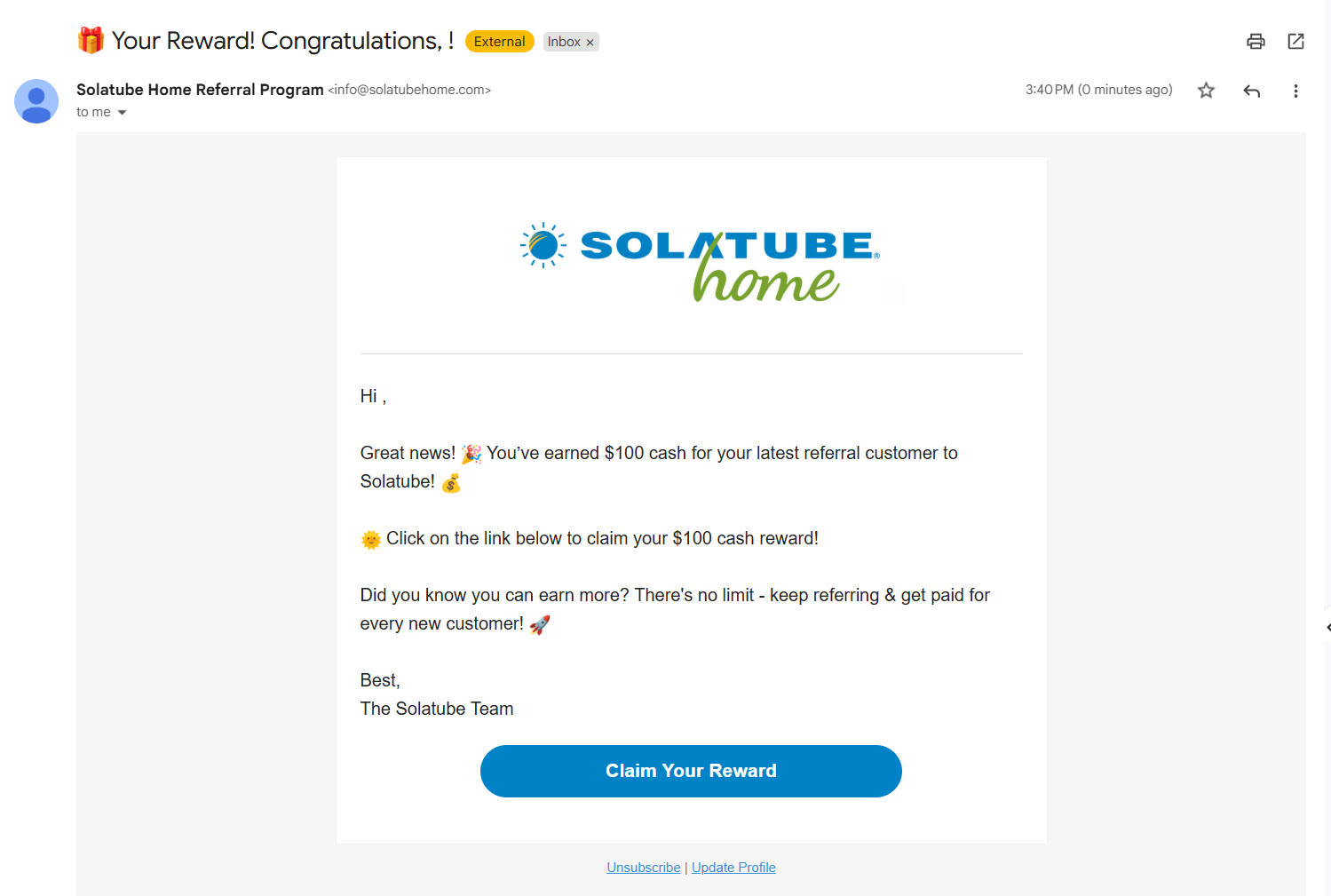
After the referred installation is confirmed, advocates receive their $100 reward notification via email and SMS. Closing the loop with timely communication reinforces that the program delivers on its promise and motivates continued sharing.
Step 8: The Growth Loop Begins Again
Every completed installation creates a potential new advocate. Referred customers who have a great experience are enrolled into the program and begin the cycle again—recommending the service to their own networks. This compounding effect is what separates a structured referral program from one-off word-of-mouth.
Activating Early Advocates (Referral Program Launch)
A referral program is only as strong as its first wave of advocates. Solatube Home launched with a targeted strategy focused on customers who were already highly satisfied and most likely to refer—rather than broadcasting to the entire customer base at once.
Targeting the Right Customers First
- Recent installations: Customers were invited immediately after project completion, when satisfaction was at its peak and the experience was still top of mind.
- High-engagement customers: Customers who had been actively communicating with the Solatube Home team were prioritized in early outreach, as their existing relationship made them more receptive to participating.
Launch Messaging
The program's launch copy was direct and benefit-focused, making the value proposition clear for both advocates and referred customers.
Combining Digital and Offline Touchpoints
A referral program that only lives in email is easy to forget. Solatube Home reinforced the program through in-person mentions from installers at the moment of installation, combined with welcome emails that immediately provided referral links. This combination of in-person and digital activation ensured customers encountered the program when their satisfaction was highest and their motivation to share was strongest. For contractors looking to increase participation, physical leave-behinds such as flyers or referral cards at the point of installation represent an additional touchpoint worth testing.
Driving Continuous Referrals (Ongoing Promotion)
Launching a referral program is the easy part. The harder challenge is keeping advocates engaged weeks and months after they first joined—when the initial excitement has faded and daily life has moved on. Solatube Home addressed this through a layered promotion strategy that combined automated digital touchpoints with the kind of personal interaction that no automation can replace.
Automated Digital Touchpoints
- Welcome sequence: New advocates receive a welcome email and SMS immediately after enrollment, delivering their referral link and explaining how the program works.
- Seven-day follow-up: Advocates who have not yet shared receive a reminder one week after joining, re-engaging them while interest is still fresh.
- 30-day activation nudges: Subscribers who have not yet referred anyone receive messages every 30 days, gently reminding them of the program and the reward waiting for them.
- Ongoing monthly reminders: Active advocates who have referred in the past but have gone quiet receive monthly nudges to continue sharing.
- Conversion notifications: Automated alerts notify advocates whenever one of their referrals completes an installation and their reward is confirmed—closing the loop and validating the effort of sharing.
High-Touch Human Moments
Not every touchpoint should be automated. Solatube Home identified two moments where personal interaction consistently drove the strongest referral activity: during the installation itself, when the customer is most delighted, and during post-installation follow-up calls, when the experience is fresh. Installers and customer service staff were trained to mention the program naturally in these conversations—not as a hard sell, but as a genuine offer.
"I would say when our staff mentions it or email reminders [drive the most referrals]."
— Solatube Home Team
The combination of automated consistency and personal authenticity is what drives ongoing referral activity. Automation ensures no advocate is forgotten. Human interaction ensures the program feels personal rather than transactional.
Results: What Structured Word-of-Mouth Looks Like in Practice
The numbers below reflect Solatube Home's referral program performance since launch, across four markets: Texas, California (Orange County and San Diego) and Arizona (Phoenix).
The Complete Referral Funnel
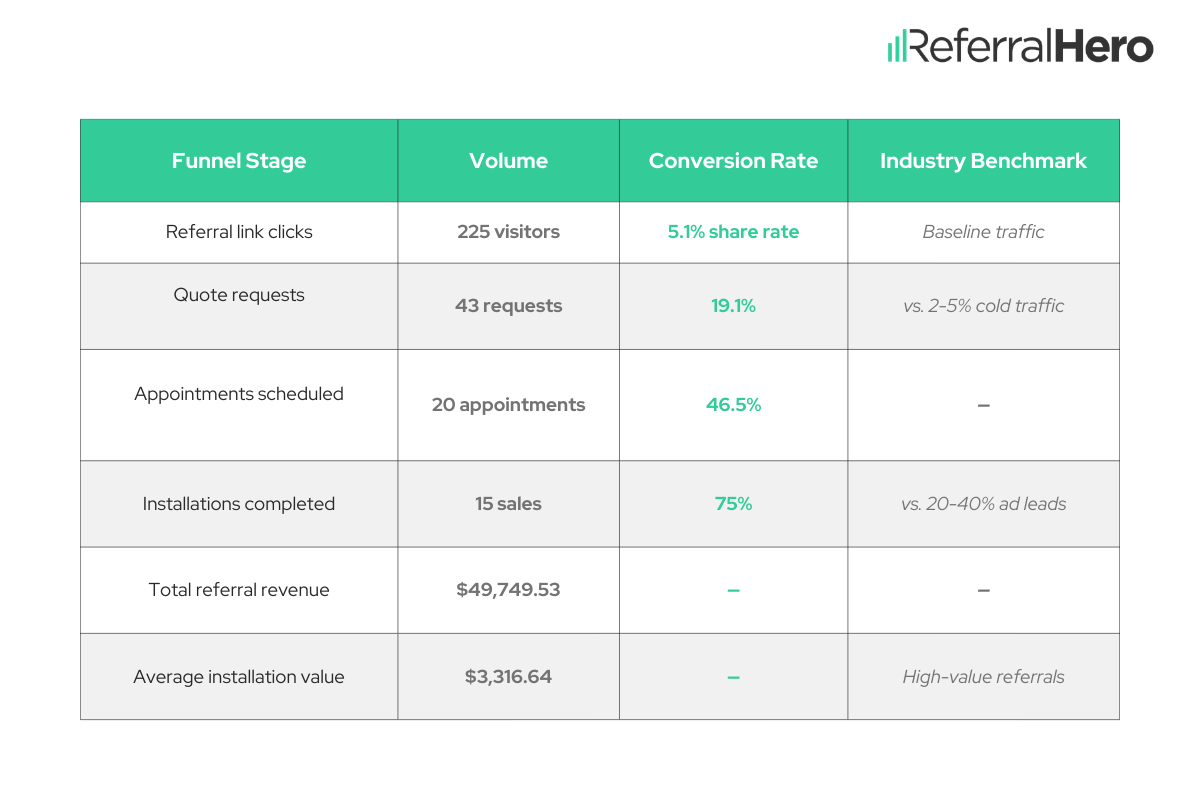
Most referral programs report top-line numbers—total referrals, total revenue. What makes Solatube Home's data compelling is the visibility it provides at every stage of the customer journey, from the first click of a referral link to a completed installation:
Advocate Engagement
Behind every referral is an advocate who chose to share. Since launch, Solatube Home has built a meaningful base of actively engaged advocates:
• 95 active advocates have shared their referral link at least once, representing a 9.7% share rate across the customer base.
• 571 total shares have been made across channels including text, email, WhatsApp, Facebook, and Messenger.
• Monthly growth in referrals has been consistent since launch, with the program showing increasing momentum rather than an early spike and plateau.
Why These Numbers Matter
A 19.1% visitor-to-quote conversion rate is exceptional in context. The home improvement industry typically sees 2-5% conversion on cold traffic from advertising—prospects who arrive with no prior relationship to the brand, no established trust, and no personal recommendation driving them. Referred visitors arrive with all three. They have seen a neighbor's installation, heard a firsthand recommendation from someone they trust, and have a $100 incentive waiting for them when they take the next step.
The 75% appointment-to-installation conversion tells a similar story. Home improvement leads from traditional advertising convert at 20-40% at this stage, often requiring significant sales effort to move prospects across the finish line. Referred customers have already made a psychological commitment before the appointment. The conversation is a confirmation, not a pitch.
At $3,316.64 average ticket value, referral customers are also investing in quality installations rather than shopping for the lowest price. This matters for the long-term economics of the program: a $100 referral reward against a $3,316 average sale represents a customer acquisition cost far below what traditional advertising delivers at comparable conversion rates.
Multi-Market Validation
Perhaps the most strategically significant result is geographic. Referral sales have been confirmed across Texas, California (Orange County and San Diego), and Arizona (Phoenix). This is not a program that works in one market because of a specific customer demographic or local dynamic—it is a system that replicates across diverse regions because it is built on a universal behavior: people recommending services they trust to the people they know.
The Moment It Became Real
Metrics validate a program. But the sign that a referral program has genuinely taken hold is often something harder to quantify—an internal shift in how the team and the customers talk about it.
"I think the buzz that it created with our customers and our team is when I realized this could really become more than it is. We've also seen an increase in referrals each month, so that's a positive trajectory."
— Solatube Home Team
Monthly growth in referrals means the program is not coasting on early momentum. It is building. Each installation adds a potential new advocate to the base, and each advocate who shares creates the next wave of referred visitors moving through the funnel.
Business Impact Beyond Lead Generation
The referral program's value to Solatube Home extends beyond the revenue it has directly generated. It has also functioned as a strategic buffer—a channel that can be leaned on when paid advertising slows down or business conditions shift.
"I think it has taken some of the stress off of us to generate more leads and given us a great tool to incentivize leads when business is slow."
— Solatube Home Team
This is the compounding advantage of a well-run referral program: it does not just generate leads, it creates a reliable channel that operates independently of ad spend, algorithm changes, or seasonal fluctuations.
Key Lessons for Home Improvement Contractors
Solatube Home's experience offers a practical blueprint for home improvement contractors considering a referral program. These are not general principles—they are specific decisions that shaped the program's results.
1. Lead with the Right Incentive, Not Just Any Incentive
The previous $50 off future installation failed not because the amount was wrong, but because it solved the wrong problem. A customer who has just completed a project isn't thinking about their next installation—they're thinking about telling their neighbor how it went. The shift to $100 cash-equivalent rewards for completed referrals aligned the incentive with what customers actually wanted at the moment they were most likely to share. Getting the incentive design right is more important than the size of the reward.
2. Tie Rewards to Installations, Not Inquiries
Rewarding advocates only after a referred customer completes an installation is the mechanism that maintains referral quality. Programs that reward on initial lead submission encourage advocates to refer anyone regardless of genuine interest. By requiring an installation to trigger the reward, Solatube Home created a natural incentive for advocates to refer people who are actually considering the service—which is reflected in the 75% conversion rate from appointments to completed installations.
3. Make the Program Easy Enough for Your Team to Explain in 30 Seconds
"Make it easy for your customer to join the program and get yourself and whole team familiar with the program so that you can properly explain it to the customer & avoid issues."
— Solatube Home Team
A referral program that the sales team doesn't fully understand will never reach its potential. Installers and customer service staff are the most effective promotional channel Solatube Home has—but only because they are confident enough in the program to mention it naturally. Training the team is not optional; it is foundational.
4. Combine Automation with Human Touchpoints
The digital automation—welcome emails, follow-up sequences, monthly reminders, conversion notifications—keeps advocates in the loop without requiring manual effort. But the data shows that human touchpoints, specifically staff mentions during and after installation, remain the most effective driver of new referrals. Automation creates consistency. Human interaction creates trust. The most effective referral programs need both.
5. Think in Compounding Terms, Not Campaigns
"I see us getting more momentum with referrals per month and would like to see a higher invoice amount per referral."
— Solatube Home Team
A referral program is not a campaign with a start and end date. Every new customer is a potential advocate. Every completed installation adds to the base of people who can refer the next wave of customers. The monthly growth trend Solatube Home is seeing reflects this compounding dynamic—and it is the reason the program's impact grows over time rather than flattening out.
Frequently Asked Questions
What was Solatube Home's referral program conversion rate?
Solatube Home achieved a 75% conversion rate from scheduled appointments to completed installations—nearly double the 20-40% conversion rate that home improvement contractors typically see from advertising leads. This reflects the pre-qualified, trust-driven nature of referred customers who arrive with a personal recommendation already in place.
How much revenue did Solatube Home generate from their referral program?
Since launch, Solatube Home has generated $49,749.53 in confirmed revenue from 15 completed referral installations, with an average installation value of $3,316.64. With monthly referral growth continuing and 95 active advocates in the program, this figure is expected to grow significantly.
What visitor-to-quote conversion rate did the referral program achieve?
19.1% of referred visitors converted into quote requests—the program's first conversion event. This is dramatically higher than the 2-5% visitor-to-lead conversion rate typically seen from cold traffic in the home improvement industry. The difference reflects the trust and intent that referred visitors bring before they ever land on the site.
Does a referral program work for high-ticket home improvement services?
Solatube Home's results suggest it works particularly well for high-ticket home improvement services. The $3,316.64 average referral installation value indicates that referred customers are not price shoppers—they arrive with established trust and a clear sense of what they want, which is why they convert at 75% from appointment to installation. High-ticket services benefit from referral programs because the trust gap that prevents cold leads from converting is already bridged before the first conversation.
What is the ROI of a referral program for a home improvement contractor?
For Solatube Home, each completed referral costs $100 in reward payouts against an average installation value of $3,316.64—a 33x revenue multiple on the direct incentive cost. Compared to a traditional lead cost of approximately $80 per lead converting at 20-40%, referral leads cost slightly more upfront but convert at nearly double the rate, making the effective cost per acquired customer substantially lower when calculated against actual installations rather than raw lead volume.
Can a referral program work across multiple geographic markets?
Yes, and Solatube Home's program demonstrates why. Referral programs are built on a behavior—personal recommendation—that is consistent across markets. The program's structure, incentives, and automation remain identical whether an advocate is in Texas or California. What varies is the specific advocates and customers, not the system itself. This makes referral programs one of the most naturally scalable acquisition channels available to multi-market service businesses.
What advice does Solatube Home have for contractors launching a referral program?
The Solatube Home team offers two recommendations grounded in their own experience: first, make it easy—both for customers to join and for staff to explain. Complexity kills participation. Second, get the whole team aligned before launch. Installers and customer service representatives are the most credible advocates for the program because they interact with customers at moments of peak satisfaction. A referral program that the team doesn't fully understand is a referral program that underperforms.
What does Solatube Home expect from their referral program in the next 6-12 months?
The Solatube Home team expects continued monthly growth in referral volume and is focused on increasing the average installation value from referral customers over time. With an already-growing base of 95 active advocates and a compounding structure where each new customer becomes a potential new referrer, the trajectory of the program points toward an increasingly self-sustaining acquisition channel.
Conclusion
Solatube Home's referral program is proof that the most effective marketing channel a home improvement contractor has is often already in place—it just isn't structured. Satisfied customers were already recommending the brand. The program didn't create that behavior; it captured it, rewarded it, and gave it somewhere to go.
The results reflect that distinction. A 19.1% visitor-to-quote conversion rate against a 2-5% industry average. A 75% appointment-to-installation conversion rate nearly double what traditional advertising delivers. $49,749.53 in revenue, a $3,316.64 average ticket, and confirmed sales across four markets. These are not the numbers of a program that is pushing customers to do something unnatural—they are the numbers of a program that made it easy for customers to do something they already wanted to do.
For home improvement contractors looking to reduce dependence on paid advertising, increase conversion rates, and build a growth channel that compounds over time, Solatube Home's experience offers a clear and replicable model. The technology is straightforward. The incentives are simple. The results are real.

