Key Takeaways
1. A finder's fee is a payment for making an introduction, not for closing the deal. The finder connects two parties — like a customer, investor, or business partner — and gets paid once that introduction leads to a real result. This makes it different from a referral fee, which usually involves an ongoing relationship between professionals in the same field.
2. Finder's fee percentages vary widely by industry, typically landing between 2% and 30% of deal value. Real estate and recruiting sit at the higher end, often 15–35%, while investment deals and SaaS referrals usually fall between 2% and 20%. In general, the larger the deal, the lower the percentage tends to be.
3. A finder's fee only holds up if the agreement is in writing before the introduction happens. The agreement needs to clearly define the trigger event, such as a signed contract or first payment, along with the fee amount and payment timeline. Verbal or after-the-fact agreements are difficult to enforce and are the most common source of disputes.
What Is a Finder's Fee?
A finder's fee is a payment made to a person or business who connects you with a customer, client, investor, or business partner that results in a completed deal. The "finder" doesn't close the deal themselves — they make the introduction, and get compensated when that introduction leads to a real outcome.
Finder's fees are used across industries — from real estate and recruiting to consulting, freelance work, and startup fundraising. They're one of the oldest and most effective ways to incentivize referrals because payment is tied directly to results, not effort.
What you'll learn in this guide:
- What a finder's fee is and how it works
- How finder's fees differ from referral fees
- What percentage to charge or pay — by industry
- How to set up a finder's fee agreement
- Legal considerations and tax treatment
- How to ask for a finder's fee professionally
Who Pays a Finder’s Fee?
A finder’s fee is typically paid by the company that was referred to.
So if you are a small business looking for new customers, then you would be paying out a finders fee.
But this doesn’t mean that you don’t get anything out of it.
A successful referral could result in an influx of new customers, which will more than pay for the finders fee (and then some).
There will also be a much higher chance that these customers fit your target market because the people pointing them in your direction REALLY want it to go well.
After all, when the referral gets off the ground, both parties start making some money.
Finder's Fee vs Referral Fee
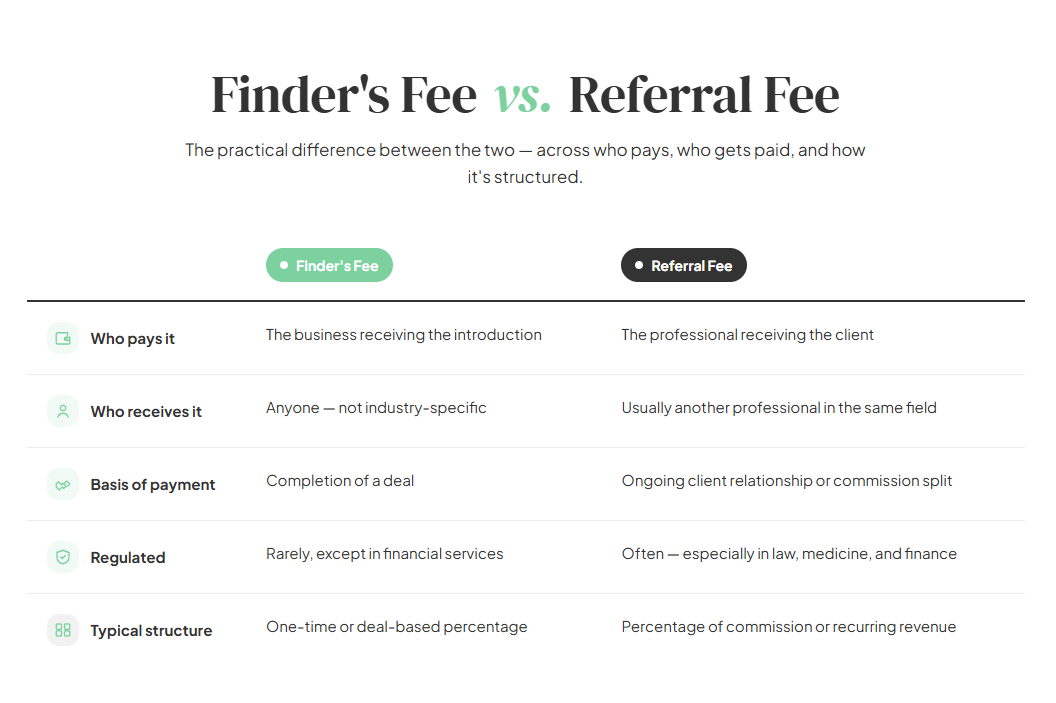
The terms are often used interchangeably, but they mean different things in practice — and confusing them can create problems when it comes to agreements, legal enforceability, and tax treatment.
Finder's Fee: A finder's fee is paid to someone who identifies and introduces a potential customer, investor, or business partner. The finder's only role is the introduction — they are not involved in negotiating or closing the deal. Finder's fees are common in real estate, investment, M&A, and business development contexts.
The key characteristic: the finder steps back once the introduction is made. What happens next is between the two parties they connected.
Referral Fee: A referral fee is typically paid between professionals or businesses in the same or adjacent fields. It's a more formal, ongoing arrangement — often governed by industry regulations — where one party sends clients or customers to another in exchange for a percentage of the resulting business.
The key characteristic: referral fees often imply a more continuous relationship between the referrer and the business being referred to, and in some regulated industries (law, medicine, financial services) they are subject to strict rules about who can receive them and how they must be disclosed.
When it matters: If you're operating in a regulated industry — financial advising, real estate brokerage, legal services — using the wrong term in a contract or paying someone who isn't licensed to receive referral fees can create legal liability. When in doubt, have an attorney review your agreement before formalizing it.
How Does a Finders Fee Work?
Traditional referrals are powerful — but without an incentive, they're inconsistent. That's why a finder's fee works: it gives the referrer a concrete reason to make introductions that stick. If you don't have a strategy for asking for referrals yet, start there first — then layer in a finder's fee structure once you have the basics in place.
A finder’s fee is basically a commission-based structure for referrals.
The person who makes the referral gets paid a percentage of the whole deal when it closes, which incentivizes them to refer more and better quality leads.
It’s generally easier to implement than other incentives and doesn’t require you to give away too much equity or revenue from your business.
A finder's fee might be a one-time deal, but usually, it extends for a longer period of time, with the ‘finder’ benefiting from long-term success with the new customer.
This can start to get complicated when trying to track exactly how much a finder’s fee should be over time, which is why a third-party software like ReferralHero can be so helpful. This tool can track and automate the entire finder’s fee financing process.
Deciding the length and percentage of the fee is up to you, but can depend on several factors, including the size of the deal, the experience of the ‘finder’, and how valuable you suspect the connection will ultimately be.
What Is a Typical Finder’s Fee?
A finder's fee need not be excessive – the most common structure is between 5-15% of the deal value (agreed upon by both parties ahead of time).
This means that if the referral turns into something big, the ‘finder’ will have a lot more to celebrate.
Finder's Fee Percentages by Industry
Finder's fee percentages vary significantly depending on the industry, deal size, and how much work the finder put in to make the introduction happen. Here's a detailed breakdown of what's standard across the most common industries.
Real Estate: 5–35% of the agent's commission
In real estate, finder's fees are paid by the agent or broker who closes the deal, not the buyer or seller directly. If an agent refers a client to another agent — say, because the client is relocating to a different market — the referring agent typically receives 25–35% of the receiving agent's commission.
Important: in most U.S. states, only licensed real estate agents or brokers can legally pay or receive finder's fees for real estate transactions. Paying an unlicensed individual a finder's fee for a real estate referral can violate state licensing laws.
Typical range: 25–35% of the receiving agent's commission
HR and Recruitment: 15–30% of the new hire's first-year salary
Recruitment finder's fees are among the highest of any industry because the value of a successful hire is significant and measurable. Executive and specialist roles command the higher end of the range; entry-level or high-volume roles sit at the lower end.
Retained search firms typically charge an upfront fee plus a success fee. Contingency recruiters only get paid when a placement is made — making their arrangement a classic finder's fee structure.
Typical range: 15–20% for general roles; 20–30% for executive or specialist placements
Investment and Venture Capital: 2–5% of capital raised
In investment contexts, finder's fees are paid to individuals or firms who introduce investors to companies seeking funding — or companies to potential acquirers. The SEC has strict rules here: anyone who regularly connects investors with investment opportunities in the U.S. may need to be a registered broker-dealer. Unregistered finders operating in securities transactions can face significant legal penalties.
For private equity and M&A transactions, finder's fees are sometimes called "success fees" and are typically negotiated as a percentage of the total deal value.
Typical range: 2–5% of capital raised; 1–3% for larger M&A transactions
Consulting: 5–20% of project revenue
In consulting, finder's fees are common when one consultant or firm refers a client to another. The range depends heavily on the size of the engagement and how warm the introduction was — a cold introduction to a prospect is worth less than a direct referral from a trusted relationship.
Some consulting arrangements structure finder's fees as a recurring percentage of revenue from the referred client for the duration of the relationship, not just the first project.
Typical range: 5–10% for project referrals; up to 20% for high-value long-term engagements
Freelance: 2–10% of project value
Freelance finder's fees are the least formalized of any category — many freelancers operate on informal reciprocal referral arrangements with no written agreement. When fees are formalized, they're typically a one-time percentage of the referred project's value.
Given the relatively low deal sizes in most freelance markets, even a small percentage can add up meaningfully over time if referral relationships are cultivated consistently.
Typical range: 5–10% for most freelance referrals
SaaS and Technology: 10–20% of first-year contract value
In SaaS, finder's fees often overlap with affiliate and partner program structures. Someone who refers a new customer to a software platform typically receives a percentage of the first year's subscription value — sometimes recurring annually if the contract renews.
This is the category most relevant to ReferralHero customers, and it's where a formal referral program structure (rather than an informal finder's fee arrangement) tends to deliver more consistent, trackable results.
Typical range: 10–20% of first-year contract value; some programs offer recurring commissions
A note on deal size: Finder's fee percentages generally decrease as deal size increases. A 10% finder's fee on a $5,000 consulting project is reasonable; a 10% fee on a $5 million M&A transaction would be excessive. The larger the deal, the more the percentage is negotiated down — but the absolute dollar value of the fee remains significant.
Is a Finder's Fee Legally Enforceable?
Yes — but only under the right conditions. A finder's fee is legally enforceable when it meets the same basic requirements as any contract: there must be a clear agreement between both parties, defined terms, and documented evidence that both sides agreed before the introduction was made.
The most common reason finder's fee disputes end up in court is that the agreement was verbal, vague, or made after the fact. If there's no written record of what was agreed before the finder made the introduction, collecting the fee becomes extremely difficult regardless of how valuable the connection turned out to be.
How to Set Up a Finder's Fee Agreement
A finder's fee agreement doesn't need to be complicated — but it does need to exist in writing before any introduction is made. A handshake deal or verbal agreement leaves both parties exposed if the arrangement is ever disputed.
Here's what every finder's fee agreement should cover:
1. Identification of Both Parties:Clearly name the finder (the person or business making the introduction) and the recipient (the business paying the fee). Include legal business names, not just trading names, and note whether each party is an individual or a registered business entity.
2. Description of the Service:Define exactly what the finder is being paid to do. This should specify:
- What kind of introduction or referral qualifies
- What industries, geographies, or customer types are in scope
- Whether the finder has exclusivity or whether the recipient can work with multiple finders simultaneously
3. The Trigger Event:This is the most important clause in the agreement. Define precisely what event triggers the fee — and make sure both parties agree on it before any introduction is made. Common trigger events include:
- A signed contract between the recipient and the referred party
- A closed financial transaction
- A first payment received from the referred party
- A completed project milestone
Vague language like "when the deal goes through" is the most common source of finder's fee disputes. Be specific.
4. Fee Structure:Specify exactly how the fee is calculated:
- Flat fee or percentage of deal value
- If percentage — percentage of what, exactly (gross revenue, net revenue, contract value, commission)
- Whether the fee is a one-time payment or recurring
- If recurring — for how long and under what conditions it continues or terminates
5. Payment Terms:Define when and how the fee will be paid:
- Timeline after the trigger event (e.g., within 30 days of deal close)
- Payment method (bank transfer, check, platform payment)
- Whether partial payments are made for partial deals or staged transactions
- Late payment terms if applicable
6. Exclusivity and Non-Circumvention:If the finder wants protection against being cut out of a deal after making the introduction, include a non-circumvention clause. This prevents the recipient from bypassing the finder and dealing directly with the introduced party to avoid paying the fee.
This clause is especially important in investment and M&A contexts where the time between introduction and deal close can be months or years.
7. Confidentiality:Specify what information shared during the finder's fee arrangement — about the business, its customers, or its financials — is confidential and cannot be disclosed to third parties.
8. Duration and Termination:Define how long the agreement is active and what happens to introductions made during the agreement period if the arrangement is later terminated. A typical clause covers introductions made during the agreement period for a defined period afterward — often 12–24 months.
9. Governing Law:Specify which state or country's law governs the agreement. This matters if the finder and recipient are in different jurisdictions.
A practical note: For small, straightforward arrangements — a freelancer referring a client to a colleague, for example — a simple one-page letter of agreement covering the trigger event, fee percentage, and payment timeline is sufficient. Reserve the full agreement structure above for higher-value or longer-term arrangements where the stakes justify the formality.
As with the legal considerations noted in the previous section, for any significant transaction have an attorney review the agreement before signing.
When finder's fees are restricted or prohibited
Certain industries have strict regulations around who can legally receive a finder's fee — and ignoring them can result in penalties, voided contracts, or personal liability.
Securities and investment: In the United States, the SEC requires anyone who regularly connects investors with investment opportunities to be a registered broker-dealer. Paying an unregistered individual a finder's fee for facilitating a securities transaction can expose both parties to legal risk. This is one of the most frequently misunderstood areas of finder's fee law.
Real estate: Most U.S. states require anyone receiving a fee for connecting buyers, sellers, or renters to be a licensed real estate agent or broker. Paying an unlicensed person a finder's fee for a real estate transaction is illegal in many states.
Legal and medical services: Attorney referral fees are governed by state bar rules and vary significantly by jurisdiction. In medicine, the Anti-Kickback Statute prohibits paying for patient referrals in contexts involving federal healthcare programs.
Financial advice: Registered Investment Advisors (RIAs) are subject to SEC rules around solicitation fees — even informal finder's fee arrangements can trigger compliance obligations.
The three things that make a finder's fee legally sound
- Put it in writing before the introduction is made. An agreement signed after the fact is far harder to enforce and signals that the fee was an afterthought rather than a negotiated term.
- Define what triggers the fee. Is it the introduction itself? A signed contract? A closed deal? A first payment received? Ambiguity here is the most common source of disputes.
- Check industry-specific regulations. If your industry has licensing requirements or anti-kickback rules, verify before paying or receiving any fee. When in doubt, have an attorney review the agreement.
A note on jurisdiction: Finder's fee laws vary by state and country. What is standard practice in one jurisdiction may be restricted or require additional disclosures in another. This guide provides general information — it is not legal advice, and for any significant transaction you should consult a qualified attorney in your jurisdiction.
Finder's Fee Tax Treatment
Finder's fees are taxable income in virtually every jurisdiction — for both the person receiving them and, in some cases, the business paying them. Getting the tax treatment wrong is one of the most common mistakes people make when entering into finder's fee arrangements for the first time.
Here's what you need to know, organized by which side of the arrangement you're on.
If you're receiving a finder's fee
Finder's fees are treated as ordinary income — not capital gains — regardless of how the fee is structured or what triggered it. This applies whether you receive the fee as an individual or through a business entity.
Key points:
- In the U.S.: If you receive $600 or more from a single business in a calendar year, that business is required to issue you a Form 1099-NEC. You are responsible for reporting this income on your tax return even if you don't receive a 1099.
- Self-employment tax: If you regularly receive finder's fees as an individual — not through a registered business entity — the IRS may classify this as self-employment income, meaning you owe both income tax and self-employment tax (currently 15.3% on net earnings up to the annual threshold).
- Business entity: If you receive finder's fees through a registered LLC or corporation, the income flows through your business accounts and is taxed according to your entity's structure. Running fees through a business entity can simplify accounting and provide liability protection.
- Outside the U.S.: Tax treatment varies by country. In the UK, finder's fees are subject to income tax and potentially VAT depending on whether the activity constitutes a taxable supply of services. In the EU, VAT treatment depends on whether the finder is registered for VAT and the nature of the services provided.
If you're paying a finder's fee
For the business paying the fee, finder's fees are generally tax-deductible as a business expense — specifically as a sales, marketing, or commission expense.
Key points:
- Issue a 1099-NEC for any individual or unincorporated business you pay $600 or more in a calendar year. Failing to do so doesn't eliminate your deduction, but it can trigger IRS scrutiny.
- Document the business purpose. The fee must be directly tied to a legitimate business referral or introduction. Keep records of the finder's fee agreement, the introduction made, and the deal that resulted from it.
- Payments to corporations: If the finder is a registered C-corporation or S-corporation, a 1099-NEC is generally not required — but verify this with your accountant, as rules can vary.
Practical steps to keep your finder's fees tax-clean:
- Always use a written agreement that specifies the fee amount and trigger event — this creates a paper trail for both parties
- Keep records of every introduction made and every fee paid or received
- If you're receiving fees regularly, set aside 25–30% of each payment for taxes — particularly if you're subject to self-employment tax
- Work with an accountant or tax advisor for any finder's fee arrangement over $10,000 — the complexity of business structures, jurisdictions, and industry regulations makes professional guidance worthwhile at that level
This section is general information, not tax advice. Tax treatment varies based on your jurisdiction, business structure, and individual circumstances. Consult a qualified tax professional before entering into any significant finder's fee arrangement.
How Do I Ask For a Finder's Fee
Where to insert it: Replace the existing "How Do I Ask For a Finder's Fee" section — currently just 3 short paragraphs — with the version below. Keep the H2.
How to Ask For a Finder's Fee
Asking for a finder's fee is uncomfortable for most people — especially if you've been making introductions informally without ever putting a price on it. But handled correctly, the conversation is straightforward and rarely damages relationships.
Here's how to approach it professionally.
1. Establish the agreement before making the introduction
This is the single most important rule. Once you've made the introduction, your negotiating position weakens significantly — the recipient has what they need and has less incentive to agree to your terms. Always discuss and document the fee arrangement before connecting the two parties.
A simple message is enough to open the conversation:
"Before I make this introduction, I'd like to agree on a finder's fee arrangement. I typically charge X% of the deal value, payable within 30 days of close. Does that work for you?"
Short, direct, and professional. If the other party pushes back, you can negotiate — but the key is having the conversation first.
2. Know your number before the conversation
Come to the discussion with a specific percentage or flat fee in mind, not a range. Saying "I'm thinking somewhere between 5 and 15%" signals uncertainty and invites the other party to anchor at the low end. Saying "I charge 10% of the first year's contract value" is a position you can negotiate from.
Use the industry benchmarks in this guide to calibrate what's reasonable for your context. If your ask is within the normal range for your industry, it's much easier to justify.
3. Frame it around value, not entitlement
The strongest finder's fee conversations focus on the quality of the introduction, not the act of referring. There's a meaningful difference between:
"I've been referring people to you for years and never asked for anything" — which sounds like a grievance
and
"I have a warm introduction to someone who fits exactly what you're looking for — a $500K annual contract in the healthcare space. I'd like to formalize this with a finder's fee agreement before we move forward." — which sounds like a business proposition
Lead with the value of what you're bringing, not the history of what you haven't been paid.
4. Get it in writing immediately
Once you've agreed verbally, follow up with a written confirmation the same day — even if it's just an email summarizing the terms. Something as simple as:
"Just confirming our agreement: I'll receive a 10% finder's fee on the value of any deal that closes with [referred party] within 12 months of this introduction, payable within 30 days of deal close. Let me know if that matches your understanding."
A reply confirming the terms creates a written record. A full agreement (see the previous section) is better for high-value arrangements, but even an email confirmation is significantly better than nothing.
5. If you've already been making introductions for free
This is the most delicate situation. If you've been informally referring customers to a business without any fee arrangement, transitioning to a paid arrangement requires a reset conversation — not a retroactive invoice.
Approach it as a forward-looking change:
"I've really enjoyed referring clients your way and I'm glad it's been valuable. Going forward I'd like to formalize this with a finder's fee arrangement — here's what I'm thinking for new introductions from here."
Don't try to collect fees on past introductions without a prior agreement — it will almost certainly damage the relationship and is unlikely to be legally enforceable anyway.
Frequently Asked Questions About Finder's Fees
What is a finder's fee?A finder's fee is a payment made to a person or business who connects two parties — typically a buyer and seller, investor and company, or client and service provider — that results in a completed deal. The finder's role is the introduction only; they are not involved in negotiating or closing the transaction.
What is a typical finder's fee percentage?The most common range is 5–10% of the deal value for most industries, though this varies significantly by context. Recruitment finder's fees run 15–30% of a new hire's first-year salary. Real estate referral fees are typically 25–35% of the receiving agent's commission. Investment finder's fees are usually 2–5% of capital raised. The larger the deal, the lower the percentage tends to be.
Is a finder's fee legally enforceable?Yes, provided there is a written agreement in place before the introduction is made, the terms are clearly defined, and the arrangement doesn't violate industry-specific regulations. Verbal finder's fee agreements are extremely difficult to enforce. In regulated industries — securities, real estate, law, and medicine — additional licensing or disclosure requirements may apply.
What is the difference between a finder's fee and a referral fee?A finder's fee is paid to anyone who makes a valuable introduction, regardless of their professional background. A referral fee is typically paid between professionals in the same or adjacent fields and often implies a more ongoing relationship. In regulated industries, referral fees may be subject to strict rules about who can legally receive them.
Do you pay taxes on a finder's fee?Yes. Finder's fees are treated as ordinary income in virtually every jurisdiction. In the U.S., if you receive $600 or more from a single business in a calendar year, they are required to issue you a Form 1099-NEC. If you receive finder's fees regularly as an individual, the IRS may also classify this as self-employment income subject to self-employment tax.
Do finder's fees need to be in writing?Technically no — but in practice, yes. A verbal agreement is nearly impossible to enforce if a dispute arises. A written agreement, even a simple email confirmation of the terms, protects both parties and creates a clear record of what was agreed before the introduction was made.
Can anyone charge a finder's fee?In most industries, yes. However, in regulated industries — particularly securities, real estate brokerage, and financial advising — only licensed individuals or firms may legally receive fees for certain types of introductions. Paying an unlicensed person a finder's fee in these contexts can expose both parties to legal liability.
How long should a finder's fee agreement last?Most finder's fee agreements cover a defined period — typically 12–24 months from the date of introduction. This means if the deal closes within that window, the fee is owed regardless of how long the negotiation took. Duration should be agreed upon in writing before the introduction is made.
What is a non-circumvention clause in a finder's fee agreement?A non-circumvention clause prevents the business receiving the introduction from cutting out the finder and dealing directly with the introduced party to avoid paying the fee. It's most important in investment and M&A contexts where the time between introduction and deal close can be significant.
How is a finder's fee different from a commission?A commission is typically paid to someone actively involved in selling — a salesperson who pitches, negotiates, and closes deals on behalf of a business. A finder's fee is paid purely for the introduction. The finder steps back once the connection is made; a commissioned salesperson stays involved through the entire sales process.
Conclusion
A finder's fee can help bring in quality customers while supporting those who help you on your way.
Encouraging high-value referrals is a great way to give your company a boost, and with the right tools, it doesn’t need to be complicated.
I owe a lot of my success to my network. Encouraging that engagement allows me to take word-of-mouth marketing into my own hands, and now you know how to utilize this powerful technique as well!
The sooner you launch ReferralHero and invest in one of the most successful forms of marketing available, the sooner your numbers will soar.

