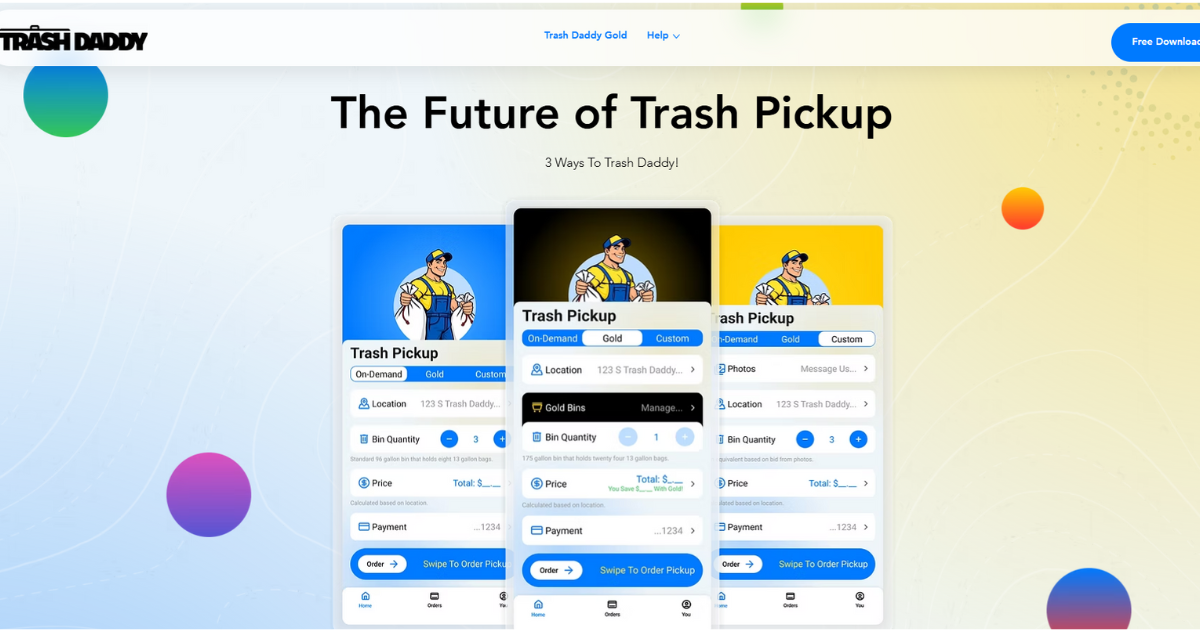
When Trash Daddy launched their referral program, they did something most local service businesses think is impossible: they turned their waste management service into a viral growth engine. In just six months, 78.7% of their subscribers came through referrals, with a remarkable 63.1% conversion rate.
This isn’t just another case study about discounts and links. This is proof that mobile-first referral programs work for offline service businesses—even when your customers aren’t tech experts, even when your service is as unglamorous as trash pickup, and even when you’re competing in a hyper-local market.
If you’ve ever thought “referral programs don’t work for businesses like mine,” Trash Daddy’s results will change your mind.
Why This Matters for Your Service Business
Let’s address the elephant in the room: you’re skeptical.
You’ve probably thought: - “My customers won’t use apps or links” - “Referrals happen face-to-face, not digitally” - “My service is too local/niche for this to work” - “I can’t afford to pay commissions forever” - “This only works for tech companies”
Trash Daddy faced every single one of these objections. A waste management service isn’t sexy. Their customers aren’t digital natives. Their service area is neighborhood-specific. Yet they built a referral program that now drives 78.7% of all new subscribers.
According to Nielsen’s Global Trust in Advertising research, 92% of consumers trust recommendations from friends and family above all other forms of advertising. For local service businesses, this trust translates directly into conversions—but only if you make it easy for customers to actually refer.
That’s exactly what Trash Daddy did. And in this case study, you’ll learn their exact strategy, see their real results, and discover how to replicate this for your service business—whether you run an HVAC company, lawn care service, cleaning business, plumbing operation, or any other local service.
Trash Daddy Referral Program Overview
The Challenge: Growing a Local Service Business
Trash Daddy provides on-demand curbside valet trash pickup services to residential customers. They offer three service tiers:
- On-Demand: Pay-per-pickup service for occasional needs
- Gold: Subscription-based bin rental with discounted per-pickup rates and bin sanitization included
- Custom: Tailored service packages for specific needs
Like most local service businesses, they faced the classic growth dilemma:
- High customer acquisition costs through traditional advertising
- Limited geographic reach (hyper-local service area)
- Low brand awareness in a commoditized industry
- Competition from established providers with bigger budgets
While they planned to invest in social media and other paid advertising, they needed referrals to be a core part of their growth strategy from day one—a scalable, cost-effective channel that didn't rely solely on ad spend.
Why ReferralHero: The Mobile-Native Challenge
Like many startups, Trash Daddy faced the classic "cold start problem"—a two-sided network with zero users at launch. But unlike most startups, they envisioned referrals as a core growth strategy from day one.
The challenge? Finding referral software that actually worked with mobile-native apps.
"We had a hard time finding any referral platform that would work in mobile native apps. The only real challenge was building the integration for our platform in-app and then rolling it out."
— Brycen Rinehart, Growth Team, Trash Daddy
Most referral platforms were built for web-based SaaS products or e-commerce stores. Trash Daddy needed something different: a solution that could integrate seamlessly into their iOS and Android apps, track referrals from mobile sharing, and provide a native user experience.
That's where ReferralHero came in. With mobile-native integration capabilities and developer-friendly APIs, ReferralHero enabled Trash Daddy to build the exact referral experience they envisioned—directly inside their app, with one-tap sharing and automatic commission tracking.
The result: Trash Daddy successfully launched their mobile-first referral program without compromising user experience or development timelines.
The Solution: Structured Referral Program with Lifetime Commissions
Trash Daddy’s vision went deeper than just customer acquisition. Founders Trendon and Andrew envisioned a referral program that would create genuine opportunity for everyone involved.
"We all have been aware of network marketing concepts for growth and wanted to extend a real opportunity for people to earn, which creates a legitimate win-win-win scenario."
— Brycen Rinehart, Growth Team, Trash Daddy
This philosophy shaped every aspect of their referral program design—from lifetime commissions to strategic partnerships with real estate agents and community organizations. The goal wasn't just to get more customers; it was to build a culture of shared success.
The program had three core components:
- Customer Incentive: 30% off first order for new subscribers
- Advocate Reward: 5% lifetime commission on every payment
- Mobile-First Experience: App-based sharing with one-tap referral links
The key differentiator? Lifetime commissions. Instead of one-time rewards, advocates earn ongoing revenue for as long as their referrals remain subscribers.
Referral Program Rewards Structure
Customer Incentive: 30% Off First Order
New customers receive a 30% discount on their first service when they sign up through a referral link. This discount is:
- Significant enough to overcome pricing objections
- Low enough to maintain profitability
- Automatically applied at checkout (zero friction)
For a service business, the discount acts as both an acquisition incentive and a trial offer—giving new customers a risk-free way to experience the quality of service before committing to full price.
Advocate Reward: 5% Lifetime Commission
This is where Trash Daddy's program gets interesting. Instead of offering a one-time $10 or $20 credit, advocates earn 5% of every trash pickup payment their referrals make—forever.
Example: If a referred customer uses the service twice a month at $20 per pickup, the advocate earns $2/month. If that customer continues using the service for 2 years, the advocate earns $48 total from that single referral. Multiply that by 10 active referrals, and advocates can earn $480+ in passive income.
Important note: The 5% commission applies to all trash pickup orders (On-Demand, Gold discounted pickups, and Custom services). The commission does not apply to the Gold bin subscription fee itself—only to the actual trash pickup charges.
Why Lifetime Commissions Work for Service Businesses
Service businesses benefit uniquely from lifetime commission structures because:
- Repeat customer behavior: Even with on-demand services, customers return regularly for the same need
- Higher lifetime value: The total value of a customer far exceeds a single transaction
- Quality over quantity: Advocates focus on referring genuinely interested customers (higher conversion)
- Compounding rewards: As advocates accumulate referrals and those customers place repeat orders, passive income grows
Self-funding: The program pays for itself through customer orders that wouldn't have existed otherwise
Trash Daddy discovered that lifetime commissions motivated advocates to:
- Refer more selectively (targeting neighbors who genuinely need regular trash pickup)
- Promote more actively (because the reward continues growing with each order)
- Stay engaged longer (to keep earning from their referrals' ongoing usage)
This creates a virtuous cycle: better referrals → more frequent usage → more advocate earnings → more referrals.
How the Referral Program Works (Step-by-Step)
Trash Daddy’s referral flow is designed for maximum simplicity:
Step 1: Existing Customer Visits Refer a Friend Page
Every Trash Daddy subscriber gets a personalized referral link through the ReferralHero platform. They can access it via: mobile app dashboard, email confirmation, or customer portal.
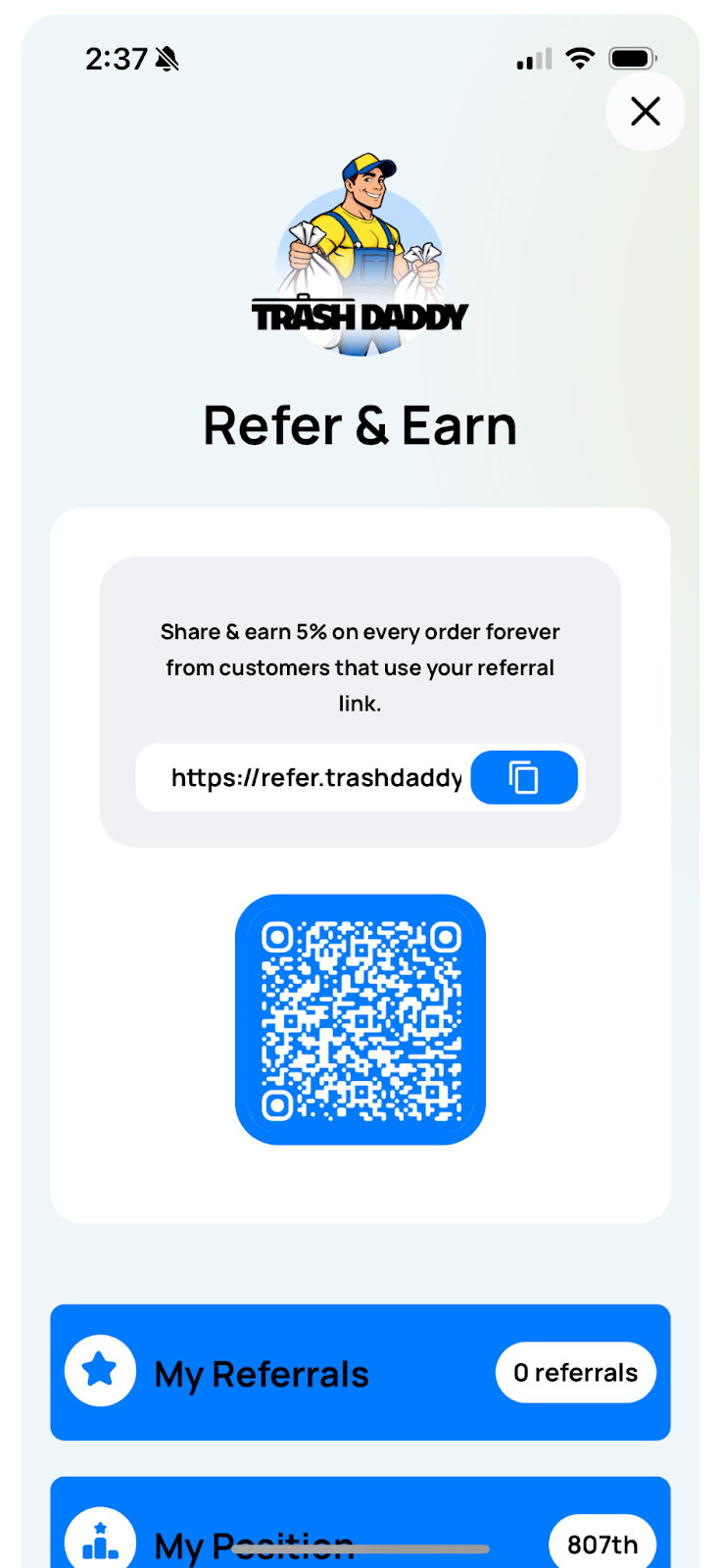
Step 2: Current Customer Shares Referral Link
When an existing customer wants to refer someone, they simply:
- Tap “Share” in the app
- Choose: Text, Email, Facebook, WhatsApp, or copy link
- Send to neighbors, friends, or family
The entire process takes less than 10 seconds—critical for busy customers who won’t jump through hoops.
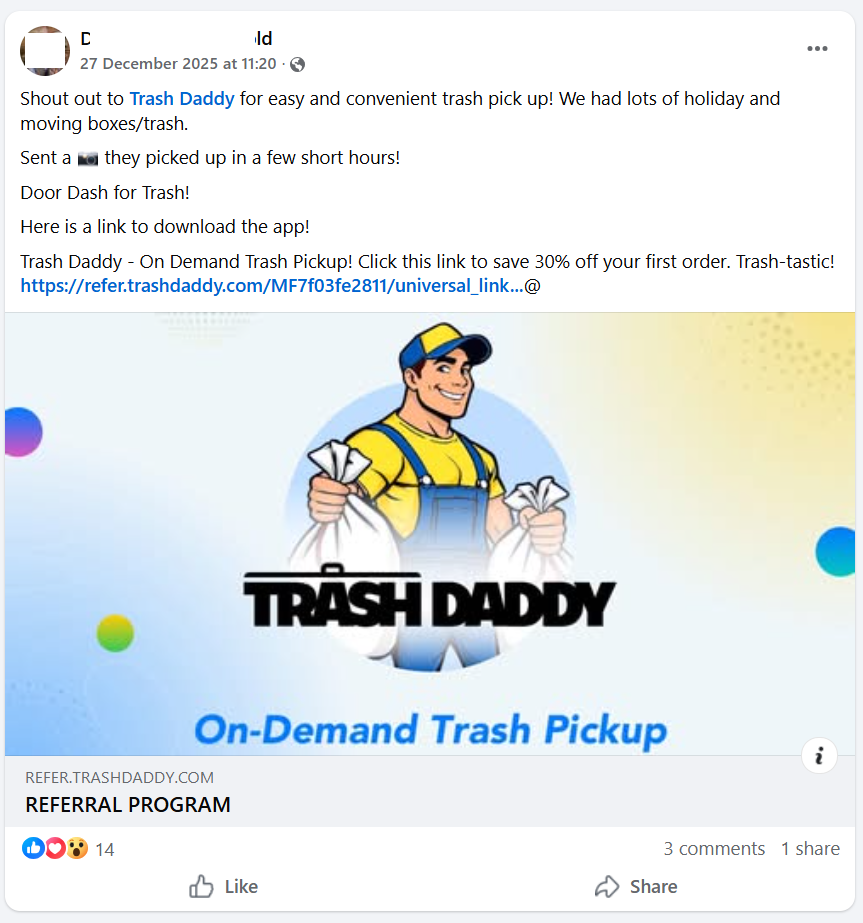
Step 3: New Customer Downloads App & Signs Up (30% Discount Auto-Applied)
When a friend clicks the referral link:
- Mobile users are redirected to the Apple App Store or Google Play Store to download the Trash Daddy app to complete signup.
- Desktop visitors are directed to a dedicated page prompting them to continue on their phone for a seamless experience.
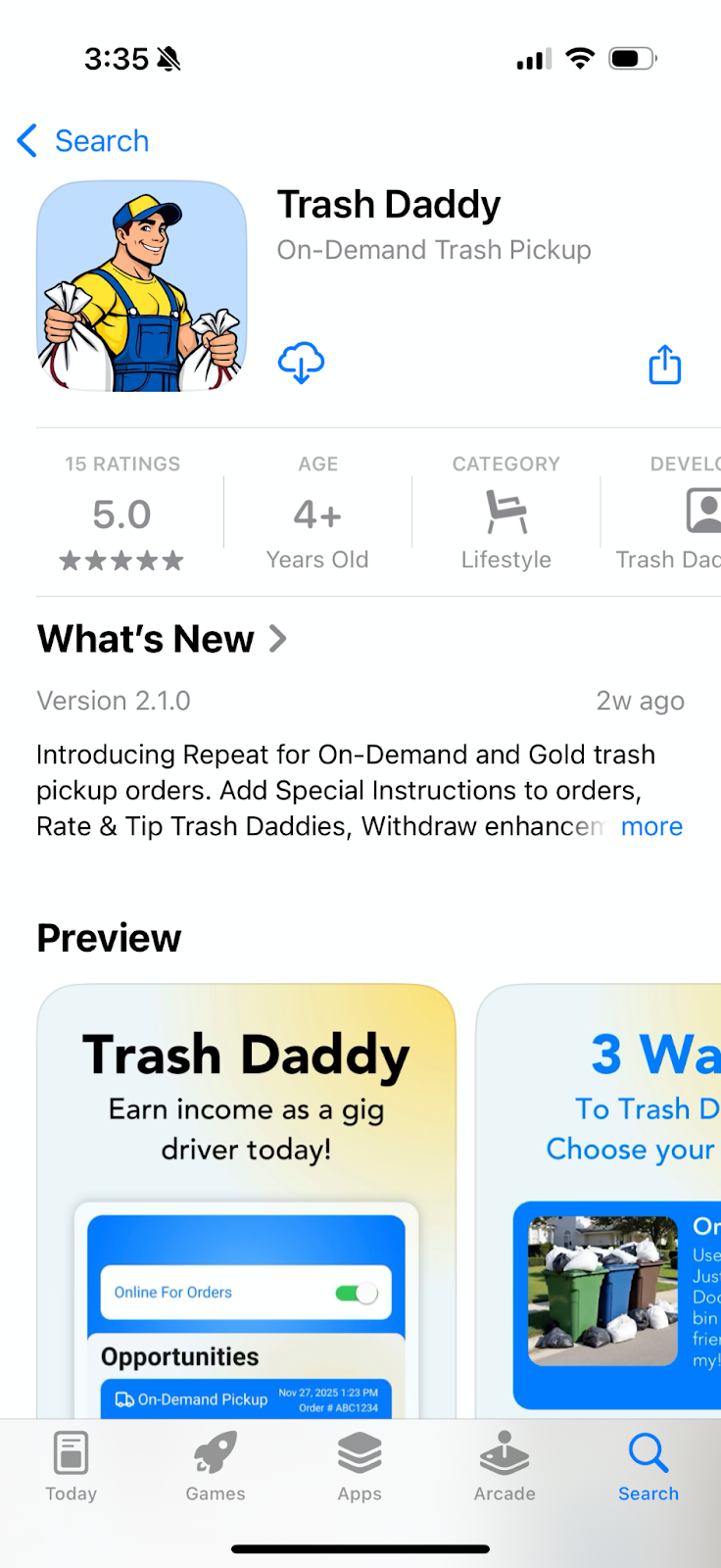
Once they download the app and create an account, they land on a mobile-optimized signup page with:
- The 30% discount already applied
- Simple service address input
- One-click subscription setup
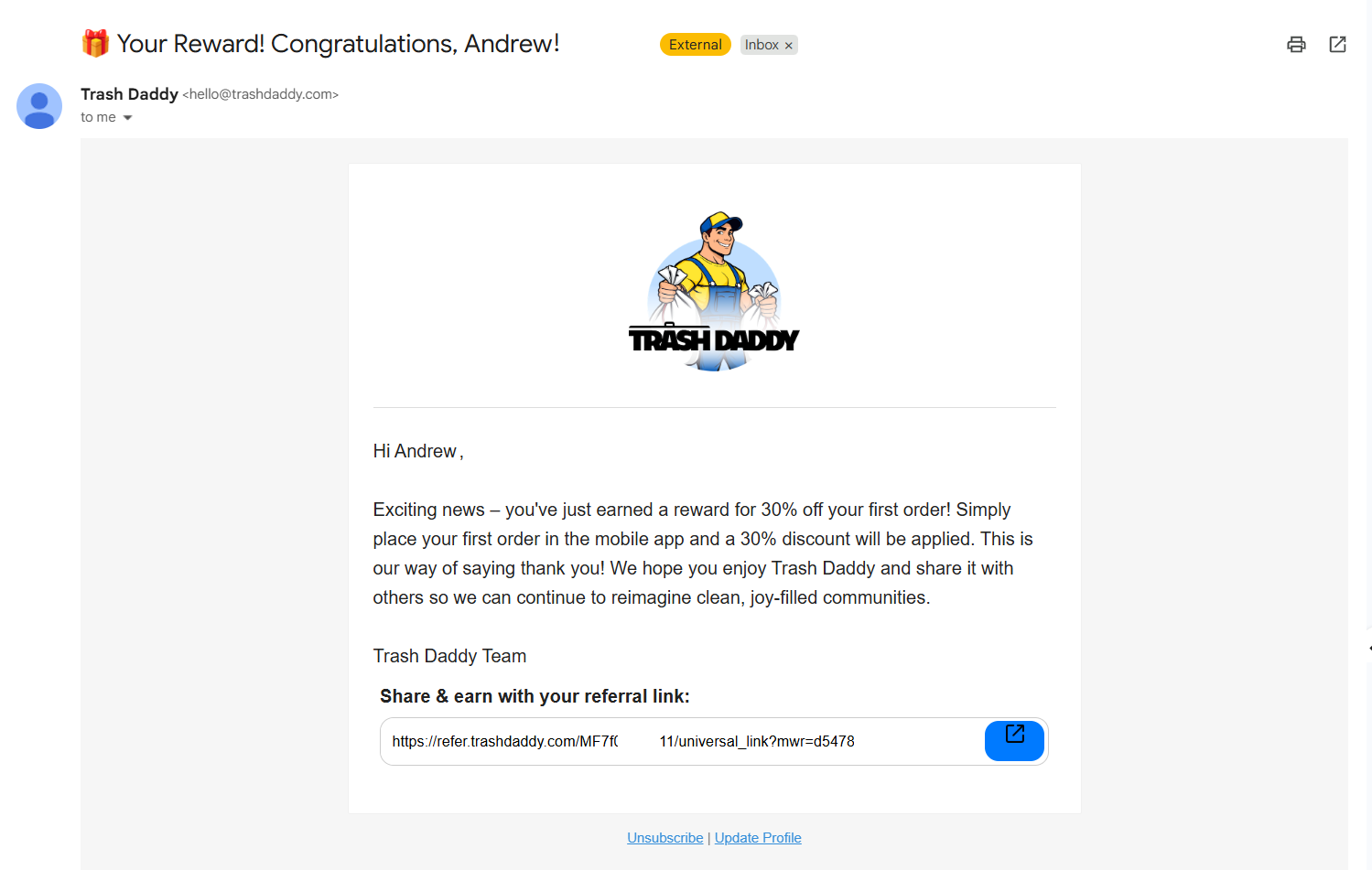
The referral is automatically tracked in the referral campaign as "Signed Up." A confirmation email is sent letting them know they've earned a 30% discount on their first order.
No referral codes to remember. No manual discount entry. Zero friction.
Step 4: First Order Placed
After the new customer signs up, they receive their first trash pickup service at 30% off. Their referral status updates to “Ordered”, ensuring accurate tracking for both the new customer and the referring advocate. The quality of service drives retention—referred customers stick around because the service delivers on the promise.
Step 5: Advocate Earns 5% Commission
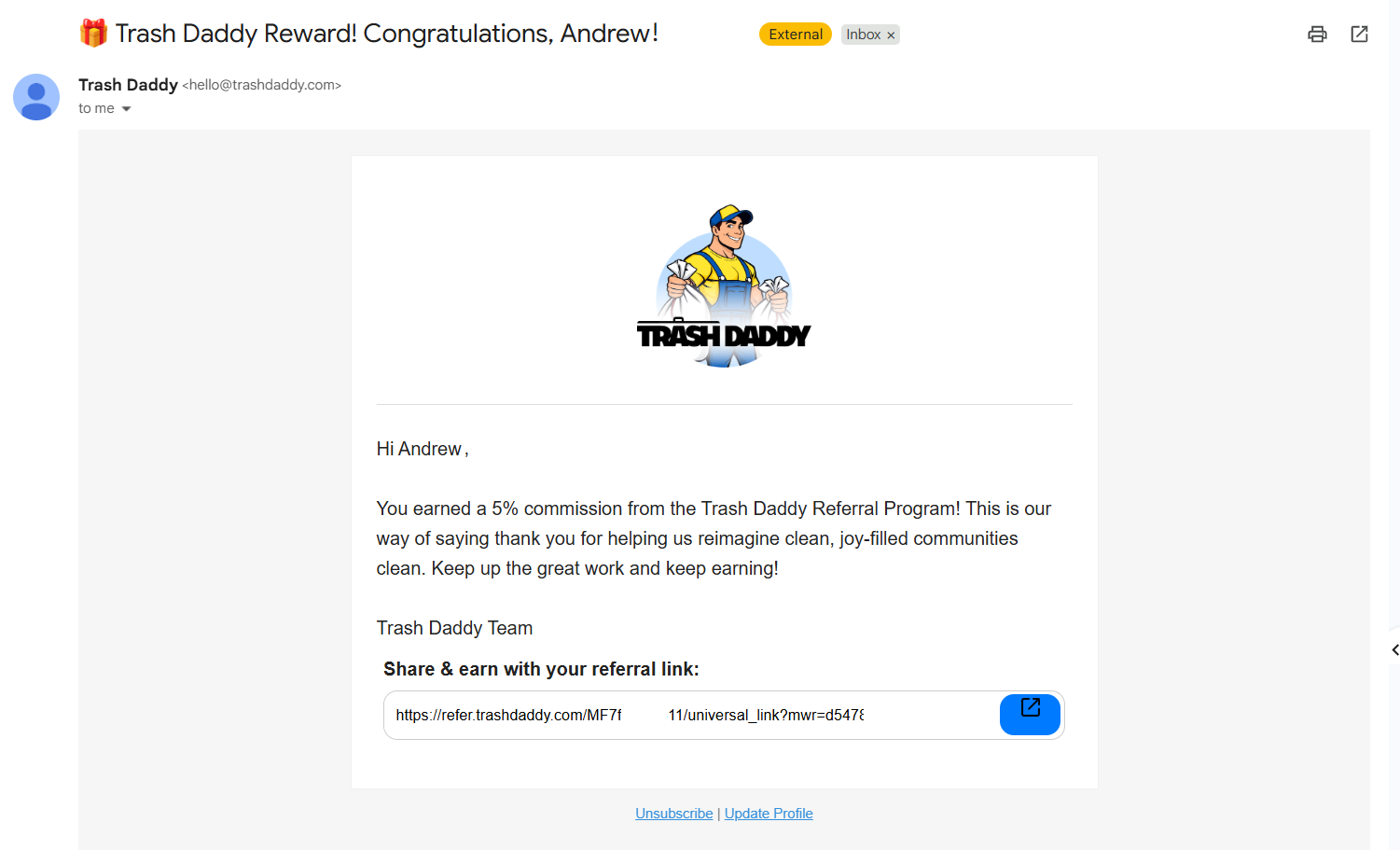
Once the referred customer’s first payment is processed, the advocate’s 5% commission is automatically calculated and credited to their account. This happens every single month the referral remains active.
Step 6: Viral Growth Loop Repeated
Satisfied referred customers eventually become advocates themselves, sharing their own links and earning lifetime commissions. This creates compound growth:
Customer A refers Customer B (A earns commission)
Customer B refers Customer C (B earns commission)
Customer C refers Customer D (C earns commission)
And so on…
This loop allows Trash Daddy to grow its customer base naturally while rewarding loyal users for helping others experience a simpler, cleaner way to manage their trash service pickup.
Referral Program Launch Strategy
Trash Daddy didn't just build the program and hope people would find it. They launched strategically by identifying and activating high-value advocates.
Strategic Partner Outreach
Rather than mass promotion, Trash Daddy focused on belly-to-belly conversations with people who had substantial networks:
Real Estate Agents & Networkers Trash Daddy positioned the referral program as a passive residual income opportunity. Real estate agents, who regularly interact with homeowners and renters, became natural advocates who could recommend Trash Daddy during property transactions or community events.
Gig Workers, Schools & Churches The program was promoted as a fundraising opportunity for organizations and an income stream for gig workers looking to supplement their earnings. By framing it as "earn 5% on every order, forever," Trash Daddy attracted advocates who saw the long-term value of building a referral portfolio.
Key Messaging:
- "Earn passive income by referring neighbors to Trash Daddy"
- "Build residual revenue—5% on every order, forever"
- "Perfect fundraiser for schools and churches"
- "Supplement your gig income with referral commissions"
This targeted approach helped Trash Daddy identify strategic partners who would actively promote the service within their existing networks.
Offline Service Touchpoints
During regular service interactions, Trash Daddy:
- Added referral program flyers to community bulletin boards
- Included referral cards with service confirmation emails
- Trained staff to mention the program during customer interactions
For service businesses, these offline touchpoints complement digital promotion and reach customers in moments of high satisfaction.
Read more about how to set up a referral program for service businesses.
Ongoing Promotion Tactics
Trash Daddy promotes their referral program through multiple channels, with a focus on organic social sharing and in-app visibility.
Facebook Posts (Primary Driver)
The most effective promotion channel has been organic Facebook posts from satisfied customers. When people share their positive experiences with Trash Daddy on social media, their friends and neighbors see real testimonials from trusted sources—not ads.
"Facebook posts from people that have enjoyed Trash Daddy [drive the most referrals]. And showing it in context in the app after people order."
— Brycen Rinehart, Growth Team, Trash Daddy
This organic social sharing creates authentic word-of-mouth that paid advertising can't replicate. Friends see their neighbors using Trash Daddy, click the shared referral link, and sign up—all within the same social platform where the recommendation was made.
In-App Messaging
After customers complete their first order, Trash Daddy displays the referral program directly in the app. This "moment of delight" promotion—when customers are most satisfied—drives consistent referral activity.
The in-app placement includes:
- Referral link prominently displayed on the dashboard
- One-tap sharing buttons
- Real-time commission earnings tracker
- Push notifications celebrating milestones
Physical Materials & Community Touchpoints
Trash Daddy supplements digital promotion with physical touchpoints:
- Referral program flyers on community bulletin boards
- Business cards with QR codes for easy mobile signup
- Service confirmation materials mentioning the program
Strategic Partnerships
As mentioned earlier, Trash Daddy actively partners with real estate agents, networkers, schools, churches, and gig workers who promote the program to their existing networks. These partnerships amplify reach beyond Trash Daddy's direct customer base.
For more ideas on promoting your referral program, check out these referral marketing strategies.
Referral Program Results (6 Months)
After six months, Trash Daddy’s referral program delivered measurable, significant results:
779 Total Subscribers (613 Referrals)
78.7% of all subscribers came through referral links—not paid ads, not door-to-door sales, not flyers. Word-of-mouth became Trash Daddy’s primary acquisition channel.
Breakdown:
- Paid advertising & organic channels: 166 subscribers (21.3%)
- Referral program: 613 subscribers (78.7%)
While Trash Daddy invested in social media and other advertising channels, referrals quickly became the dominant acquisition source.
63.1% Conversion Rate
This is the most impressive metric: 971 people visited referral links, and 613 became subscribers—a 63.1% conversion rate.
For context: Paid ad conversion rates for service businesses typically range from 2-5% - Organic search conversion rates average 5-10%. Referral conversion rates: 63.1%.
Why such a high conversion rate? Because referred customers arrive with:
- Pre-qualified need: The advocate knows they need trash service
- Built-in trust: Recommendation from a neighbor they know
- Social proof: “If it works for them, it’ll work for me”
- Immediate incentive: 30% off makes the decision easy
What These Numbers Mean for Service Businesses
Let's translate Trash Daddy's results into business impact:
Customer Acquisition Cost (CAC):
- Paid ads: Estimated $50-100 per customer (industry average for local services)
- Referral program: $2-5 per customer (30% discount on first order + 5% lifetime commission)
Customer Lifetime Value (LTV):
- Average customer places: 10-15 orders over 18 months
- Average order value: $20-40 per pickup
- Estimated lifetime value: $300-600 per customer
- Referral-driven LTV: Often higher due to better fit + social accountability
ROI Calculation:
- 613 referral customers × $450 average LTV = $275,850 in revenue
- Cost: 30% discount on first order ($12/customer × 613 = $7,356) + ongoing 5% commissions (~$13,800 total)
- Even accounting for all commissions and discounts, the program delivers 10x+ ROI
It's worth noting that Trash Daddy is still in its early scaling phase, operating in a single district with plans to expand to multiple locations. These results represent just the beginning of their referral program's potential.
"We are still only in one district and have yet to begin to scale. As we roll out more and begin to do a little marketing on social and open more districts with our 3 services now, we are seeing the fruits more."
— Brycen Rinehart, Growth Team, Trash Daddy
The 63.1% conversion rate and 78.7% referral-driven customer base were achieved in a limited geographic area with minimal traditional marketing spend. As Trash Daddy expands to new districts and increases social media promotion, these numbers are expected to compound significantly.
For service businesses struggling with high CAC from traditional advertising, these economics are transformative. Learn more about referral program rewards that work.
Key Takeaways for Service Businesses
What can HVAC companies, plumbers, roofing services, solar businesses, and other local service providers learn from Trash Daddy?
Lesson 1: Mobile-First Works (Even for “Non-Tech” Customers)
The Myth: “My customers aren’t tech-savvy. They won’t use an app or sharing links.”
The Reality: Trash Daddy’s customers are regular homeowners, many of them older demographics who’ve never participated in a referral program before. Yet 78.7% of new subscribers came through mobile sharing.
Why it worked:
- One-tap sharing: No complicated steps—just tap and send
- Familiar platforms: Customers share via text, email, or social media (tools they already use)
- No learning curve: The mobile experience mirrors sending a message to a friend
- Visual confirmation: Advocates can see their commissions tracked in the app
Takeaway for your business: Don’t underestimate your customers’ ability to use simple, well-designed mobile tools. The barrier isn’t technology—it’s complexity. Make sharing easier than not sharing. Learn how to create a mobile referral program.
Lesson 2: Lifetime Commissions Drive Quality Referrals
The Myth: “One-time rewards are simpler and cheaper.”
The Reality: Trash Daddy’s lifetime commission model might outperform traditional one-time rewards in every metric:
- Higher conversion rates (63.1% vs. industry average of 5-10%)
- Better customer fit (advocates refer neighbors who genuinely need the service)
- Longer customer retention (referred customers stay because they were well-matched)
- Motivated advocates (ongoing earnings inspire continued promotion and retention)
Why it worked: - Advocates act like business partners, not just customers. The reward grows over time, creating compound motivation. Advocates care about retention (their income depends on it) and quality trumps quantity (fewer, better referrals).
Takeaway for your business: If your service has recurring revenue, consider lifetime commissions. Yes, it’s a long-term investment. But referred customers who stick around for years generate far more value than one-time buyers acquired through discounts.
Lesson 3: Simplicity Beats Complexity
The Myth: “I need a fancy, custom-built program with gamification, tiers, and special offers.”
The Reality: Trash Daddy’s program has exactly three components: 1. 30% discount for new customers 2. 5% lifetime commission for advocates 3. One-tap mobile sharing
That’s it. No point systems. No tiered rewards. No complicated rules.
Why it worked:
- Easy to understand: Any customer can explain it in one sentence
- Easy to share: Tap, send, done
- Easy to track: Advocates see their commission earnings clearly - Easy to scale: The program runs automatically via ReferralHero
Takeaway for your business: Complexity kills participation. Your customers are busy. They won’t read a 10-step instruction manual. Keep rewards simple, sharing frictionless, and tracking transparent. If you can’t explain your program in 20 seconds, it’s too complicated.
Lesson 4: Start with Existing Customers
The Myth: “I need to wait until I have thousands of customers before launching a referral program.”
The Reality: Trash Daddy started small—with just their existing subscriber base. The first wave of referrals came from advocates who were already satisfied customers.
Why it worked: - Satisfied customers are eager to share: They’re already fans - Immediate feedback loop: Early results showed what messaging worked - Low risk: Testing with existing customers validated the program before scaling - Authentic recommendations: Real customers, real enthusiasm
Takeaway for your business: Launch now, not later. Even if you have 50 customers, 10 might become active advocates. Those 10 advocates can each refer 5 customers. That’s 50 new customers from your first month. Compound that over 6 months, and you have Trash Daddy’s results. Read our guide on how to build a referral marketing program.
Lesson 5: Automate Everything
The Myth: “I can manage referrals manually through spreadsheets.”
The Reality: Tracking 613 referrals, calculating lifetime commissions, sending automated emails, and managing unique links manually would require a full-time employee.
Why automation worked: - Referral links auto-generated: Every customer gets a unique, trackable link - Commissions auto-calculated: No manual math or payment errors - Emails auto-triggered: Welcome emails, milestone celebrations, monthly statements - Real-time reporting: Trash Daddy sees referral metrics in one dashboard
Takeaway for your business: Use referral program software from day one. ReferralHero handles all the technical complexity so you can focus on delivering great service. Manual tracking doesn’t scale, creates errors, and burns out your team.
Lesson 6: Word of Mouth Is Still King—Technology Just Makes It Scalable
The Myth: "Referral programs are just another digital marketing tactic."
The Reality: Trash Daddy's success proves that referral programs work because they harness the oldest, most powerful marketing force: word of mouth.
"Data shows that referral programs work. Nothing beats word of mouth. Everything in marketing is meant to recreate that! Having a tech platform that manages a referral program does not remove the belly-to-belly aspect in many cases. People naturally leverage their relationships when sharing because they want that person to benefit also."
— Brycen Rinehart, Growth Team, Trash Daddy
Why it worked:
- Authentic relationships: People share Trash Daddy because they genuinely want neighbors to benefit
- Trust networks: Recommendations from friends carry infinitely more weight than ads
- Technology enables, not replaces: ReferralHero automates tracking and rewards, but the core driver is still human connection
- Belly-to-belly + digital: Face-to-face conversations happen naturally; the mobile link makes the follow-through effortless
Takeaway for your business: Don't think of referral programs as a replacement for relationship-based marketing. Think of them as the infrastructure that makes word-of-mouth scalable. Your customers already talk about you—give them an easy way to turn those conversations into trackable referrals.
Common Questions About Service Business Referral Programs
Can trash pickup and waste management services run successful referral programs?
Yes. Trash Daddy’s case study proves that even commodity services in unglamorous industries can build thriving referral programs. The key is recognizing that local service businesses have built-in advantages: - Geographic concentration: Customers live near each other - Common needs: Neighbors have similar service requirements - Trust networks: Local recommendations carry extra weight - Recurring touchpoints: Regular service builds lasting relationships
Waste management, HVAC, plumbing, solar, roofing, and similar services all benefit from these dynamics. If anything, referral programs work better for local services than for tech companies—because your advocates can physically point to the results (a clean yard, working AC, organized trash pickup) when recommending you.
How do you track referrals for offline/local services?
Trash Daddy uses ReferralHero’s hybrid tracking system that works for both digital and offline referrals:
Digital Tracking:
- Unique referral links automatically track clicks and conversions
- Mobile apps make one-tap sharing easy
- All data syncs to a central dashboard
Offline Tracking:
- Customers can verbally tell friends: “Sign up and mention my name”
- ReferralHero’s name-based attribution matches first/last name to advocate accounts
- No code required—the system connects referrer to referred customer automatically
QR Codes for Physical Touchpoints:
- Print QR codes on business cards, flyers, or service confirmation letters
- Customers scan → land on referral signup page → tracked automatically
This hybrid approach ensures every referral gets credited—whether shared via text message or mentioned in a neighbor’s driveway. Learn more about referral tracking with referral codes or physical referral cards.
What’s a good commission rate for service business referral programs?
Trash Daddy’s 5% lifetime commission works because: Service cost: $40/month average Commission paid: $2/month per referral Customer LTV: $720 (18-month average) Total commission paid: ~$36 per referred customer over their lifetime Acquisition cost: Still dramatically lower than paid ads ($50-100/customer)
General guidelines by service type:
- Low-cost recurring services ($20-50/month like trash, lawn care): 5-10% lifetime
- Mid-cost recurring services ($100-300/month like cleaning, pest control): 3-7% lifetime or $25-50 one-time
- High-cost recurring services ($300+/month like premium HVAC and plumbing): 2-5% lifetime or $100-200 one-time
- One-time high-ticket services ($1,000+ like roofing, remodeling): $100-500 one-time
The key is to ensure commissions are: 1. Meaningful enough to motivate advocates 2. Sustainable enough to protect margins 3. Simple enough to explain easily
How long does it take to see results from a service business referral program?
Trash Daddy's timeline reflects their early-stage growth:
- Week 1-4: Initial referrals from strategic partners (real estate agents, networkers)
- Month 1-3: Organic Facebook sharing began driving consistent signups
- Month 3-6: In-app promotion after orders created steady referral flow
- Month 6: 78.7% of all subscribers came from referrals
"Honestly, we are still just getting to that point. As we roll out more and begin to do a little marketing on social and open more districts with our 3 services now, we are seeing the fruits more."
— Brycen Rinehart, Growth Team, Trash Daddy
Your timeline will vary based on:
- Starting with satisfied customers who want to share
- Promoting at peak satisfaction moments (like post-order)
- Leveraging both digital (in-app, social) and offline (partnerships) channels
- Offering clear, compelling rewards
For most service businesses, expect first referrals within the first few weeks and meaningful traction within 30-90 days. The key is consistent promotion across multiple touchpoints. Learn more about referral program timelines.
Can small local businesses afford lifetime commission referral programs?
Short answer: Yes—because you only pay commissions on revenue you wouldn't have otherwise received.
Without referral program:
- 0 new customers from referrals
- $0 revenue
- $0 cost
With referral program:
- 613 new customers
- $275,850 in revenue (based on $450 average LTV per customer)
- ~$13,800 in commissions paid over 18 months
- ~$7,356 in first-order discounts
Even after paying $21,156 in total program costs, Trash Daddy generated $254,694+ in net new revenue they wouldn't have received otherwise.
Compare to paid advertising:
- 613 customers via paid ads at $75/customer CAC = $45,975 upfront cost
- 613 customers via referral program = $7,356 initial discount cost + $13,800 spread over 18 months
The referral program is both cheaper upfront and more profitable long-term (higher retention, lower churn).
Do mobile-first referral programs work for service businesses?
Absolutely. In fact, they work better for service businesses because:
- Local sharing is mobile: People text their neighbors, message on community Facebook groups, and share on WhatsApp—all mobile platforms
- In-the-moment recommendations: When a neighbor asks “Who does your trash pickup?” advocates can share their link right then via text (mobile), not “Let me email you later” (desktop)
- Lower barrier to entry: Advocates don’t need to remember to log into a website—they tap a button in an app they’re already using
- Better tracking: Mobile apps keep the referral program top-of-mind with push notifications and dashboard widgets
Trash Daddy’s 63.1% conversion rate proves that even “non-tech-savvy” customers will use mobile tools when they’re designed well. The key is making the mobile experience as simple as sending a text message.
Why is mobile integration more challenging than web-based referral programs?
Trash Daddy discovered that integrating a referral program with mobile-native apps requires significantly more upfront development work than web-based implementations.
"Be aware that integrating with a mobile native app is more work for sure and up front dev cost and time!"
— Brycen Rinehart, Growth Team, Trash Daddy
Why mobile is harder:
- Native app integration: Unlike web platforms where you can embed widgets, mobile apps require SDK integration or custom API development
- Platform-specific code: Separate implementations for iOS and Android
- App store review: Changes require approval processes that web apps don't face
- Deep linking complexity: Ensuring referral links open the app correctly on different devices
Why ReferralHero made it easier:
- Developer-friendly APIs: Clean documentation and endpoints designed for mobile integration
- Mobile-native tracking: Built-in support for app-to-app referral flows
- Technical support: Development team assistance during implementation
If you're running a mobile-first service business, choose referral software that's built with mobile apps in mind—not just retrofitted from web-based platforms.
The Bigger Vision: Building a Culture of Opportunity
For Trash Daddy, the referral program isn't just about acquiring customers—it's about creating a business model where everyone wins.
"It aligns with what we envisioned from the beginning. We want to create a culture of opportunity for everyone involved! Clean, joy-filled communities is what we are striving to create in the world. We are excited to see it continue to blossom!"
— Brycen Rinehart, Growth Team, Trash Daddy
This vision manifests in three ways:
- Customers win: They get reliable, high-quality trash pickup service at a discounted rate when referred
- Advocates win: They earn genuine passive income by helping neighbors discover a service they genuinely benefit from
- Trash Daddy wins: They grow sustainably through trusted recommendations rather than expensive advertising
"We plan to move forward with our existing reward structure and hope to see it generate a lot of virality as we scale more!"
— Brycen Rinehart, Growth Team, Trash Daddy
As Trash Daddy expands into new districts and scales their three-tier service offering, their referral program will continue to be the foundation of growth—proving that purpose-driven businesses can scale without sacrificing their values.
Want to see how ReferralHero can help your service business achieve similar results?
- Book a demo to see how ReferralHero works for service businesses
- Read more success stories: Oregon Shines case study (120%+ referral growth using gift card rewards)
Your customers are already recommending you to their friends—now give them a reason to do it more often!

