Key Takeaways
1. A referral program is a formalized version of word-of-mouth, using tracking links and automated rewards instead of leaving recommendations to chance. It's distinct from organic word-of-mouth, affiliate marketing, and influencer marketing, since it targets existing customers who genuinely like a business and rewards them through a trackable link once a specific action, like a purchase, actually happens.
2. Referred customers consistently outperform other customers across nearly every business metric. They convert 3-5x faster than other traffic, have a 16% higher lifetime value, retain 37% better, and are four times more likely to refer others themselves. Yet despite 83% of customers saying they're willing to refer, only about 29% actually do without a structured system prompting them.
3. A referral program isn't a fix for a weak product, and it works best under specific conditions. It performs best when customer satisfaction is genuinely high, purchases repeat over time, and the value proposition is easy to explain, but it can backfire if churn is already high or if the business can't handle an influx of new customers, since a referral program mainly amplifies whatever sentiment, positive or negative, already exists.
Quick Answer:
A referral program is a structured marketing strategy where businesses reward existing customers, employees, or partners for recommending their products or services to new potential customers. Unlike organic word-of-mouth, referral programs use unique tracking links or codes to monitor who made each recommendation, then automatically deliver rewards when those referrals result in specific actions like purchases or signups. These programs work because 92% of consumers trust recommendations from people they know over traditional advertising. Businesses across all industries use referral programs to reduce acquisition costs, boost customer loyalty, and grow sustainably through their most valuable asset: satisfied customers.
Welcome to ReferralHero, where every customer becomes a potential growth engine for your business. Think of us as the friend who always knows exactly who to introduce you to at a party—except we help you turn those introductions into revenue.
You’ve probably been part of a referral program without even realizing it. That time your friend sent you a “Get $10 off!” code for their favorite meal kit service? Referral program. When your coworker scored a bonus for recommending you for a job opening? That’s a referral program too.
The interesting part isn’t just that these programs exist everywhere—it’s that they work ridiculously well. While businesses pour millions into ads that people scroll past, referred customers show up already trusting you, spend 25% more on their first purchase, and stick around 37% longer than customers from other channels.
So if you’re wondering whether referral programs are worth the effort, or if they’re just another marketing trend, you’re in the right place. This guide breaks down exactly what referral programs are, how they actually function behind the scenes, and whether they make sense for your specific business.
Let’s dig in.
What Is a Referral Program?
At its core, a referral program is a formalized system that turns word-of-mouth marketing into a trackable, scalable growth channel.
Instead of encouraging your happy customers to tell their friends about you, you create a structured process that rewards them for doing exactly that. You give them a unique link, code or ID, they share it with people in their network, and when someone uses that link to make a purchase (or complete another valuable action), both parties get rewarded.
Think of it as the difference between casually mentioning a restaurant to a friend versus having that restaurant actively incentivize you with free appetizers every time someone you refer makes a reservation using your name.
The key elements that make something a true referral program:
- Tracking mechanism – Unique links, codes, or identifiers that identify who made each referral
- Qualifying actions – Specific behaviors that trigger rewards (purchases, signups, trials)
- Reward structure – Clear incentives for the person making the referral, the new customer, or both
- Automated fulfillment – Systems that detect qualifying actions and distribute rewards without manual intervention
What a Referral Program Is NOT
There’s some confusion around terms, so let’s clarify what referral programs aren’t:
Not just word-of-mouth marketing: While referral programs leverage word-of-mouth, referral programs use unique tracking links, codes, or unique IDs to monitor and reward specific referrals. Organic word-of-mouth happens naturally without incentives or tracking.
Not affiliate marketing: Affiliate programs typically target professional marketers or content creators who promote products for commission. Referral programs target your existing customers who share because they genuinely love what you offer.
Not influencer marketing: Influencer partnerships involve paying creators with large followings to promote your brand. Referral programs work with everyday customers who have smaller, more trusted networks.
The distinction matters because each strategy serves different purposes and yields different results. Referral programs sit in a sweet spot: more authentic than paid advertising, more scalable than organic word-of-mouth, and more cost-effective than influencer partnerships.
How Does a Referral Program Work?
Understanding the mechanics helps demystify why referral programs deliver such strong results. Let me walk you through the typical journey.
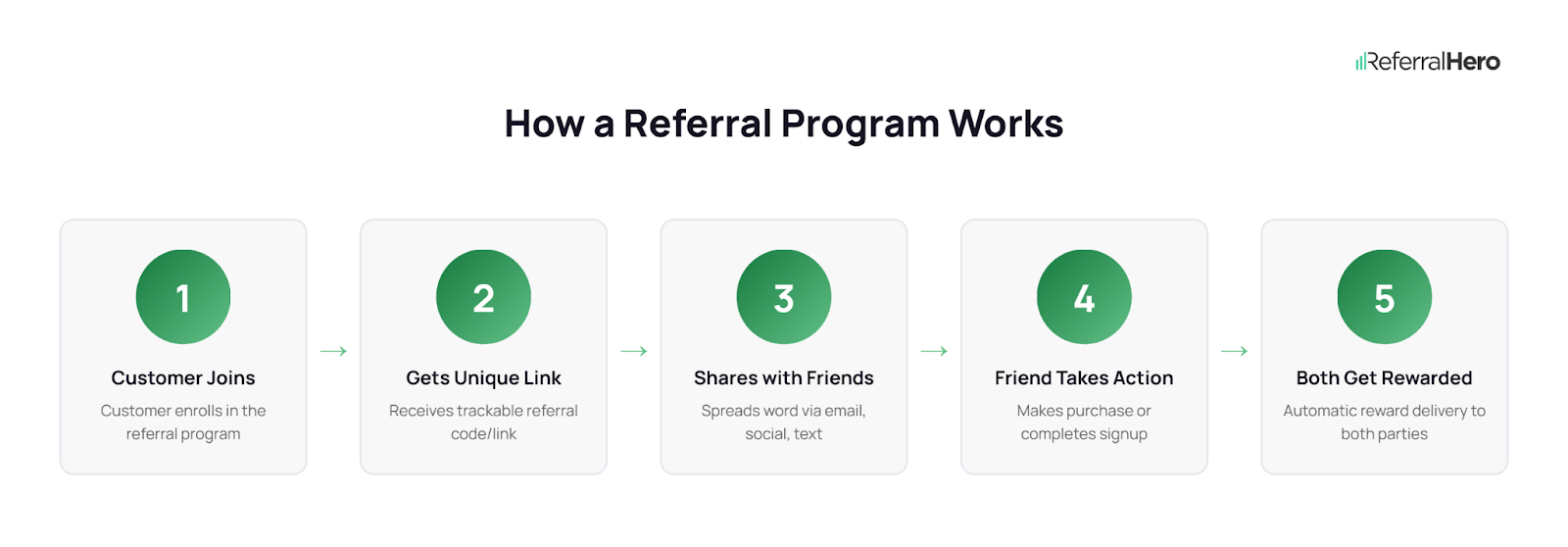
The 5-Step Referral Process
Step 1: Enrollment A customer (let’s call her Sarah) discovers your referral program through an email, in-app notification, or dedicated landing page. She decides to participate and clicks to join.
Step 2: Receiving Unique Tracking Sarah instantly receives her personalized referral link—something like yourcompany.com/ref/sarah-m-8472. This link contains a unique identifier that tracks any activity stemming from her shares.
Step 3: Sharing Sarah shares her link with friends via email, text message, or social media. Modern referral software makes this incredibly easy with pre-written messages and one-click sharing buttons.
Step 4: Conversion Sarah’s friend Mike clicks the link, browses your site, and makes a purchase. The tracking code in Sarah’s link records Mike as her referral.
Step 5: Reward Delivery Once Mike completes the qualifying action (in this case, a purchase), the referral program automatically detects it and triggers rewards. Sarah might receive $20 in account credit, while Mike gets 15% off his purchase.
All of this happens automatically, without anyone manually checking spreadsheets or processing reward requests.
The Technology Behind Modern Referral Programs
Three decades ago, referral tracking meant keeping paper punch cards or handwritten logs. Today’s referral programs run on specialized software that handles:
Unique Link Generation: Every participant gets a trackable URL or code that ties directly to their account
Attribution Tracking: The system monitors which referred visitors take action and correctly credits the right person
Fraud Prevention: Advanced algorithms detect suspicious patterns like self-referrals or fake accounts
Automated Fulfillment: When qualifying actions occur, rewards are instantly delivered via the method you’ve specified
Analytics and Reporting: Detailed dashboards show program performance, top referrers, conversion rates, and ROI
This automation is what transforms referral marketing from a manual headache into a scalable growth engine.
Want to see how to actually set up these systems? Check out how referral links work and browse our referral program templates for practical implementation examples.
Why Are Referral Programs Effective?
The data tells a compelling story. Let me show you why referral programs consistently outperform other acquisition channels.
The Psychology of Trust
Here’s the fundamental truth: people trust people far more than they trust companies.
Nielsen research consistently shows that 92% of consumers trust recommendations from friends and family over any other form of advertising. That’s not a small advantage—it’s a complete shift in how decisions get made.
When someone you trust tells you about a product, they’re lending their reputation to that endorsement. They’ve used it, liked it, and think you will too. That carries infinitely more weight than a company claiming they’re the best.
This is social proof in action. We’re hardwired to look at what others are doing, especially people we know and respect, to guide our own choices.
The Business Benefits (Backed by Data)
The psychological advantages translate into measurable business outcomes. Here’s what the research shows:
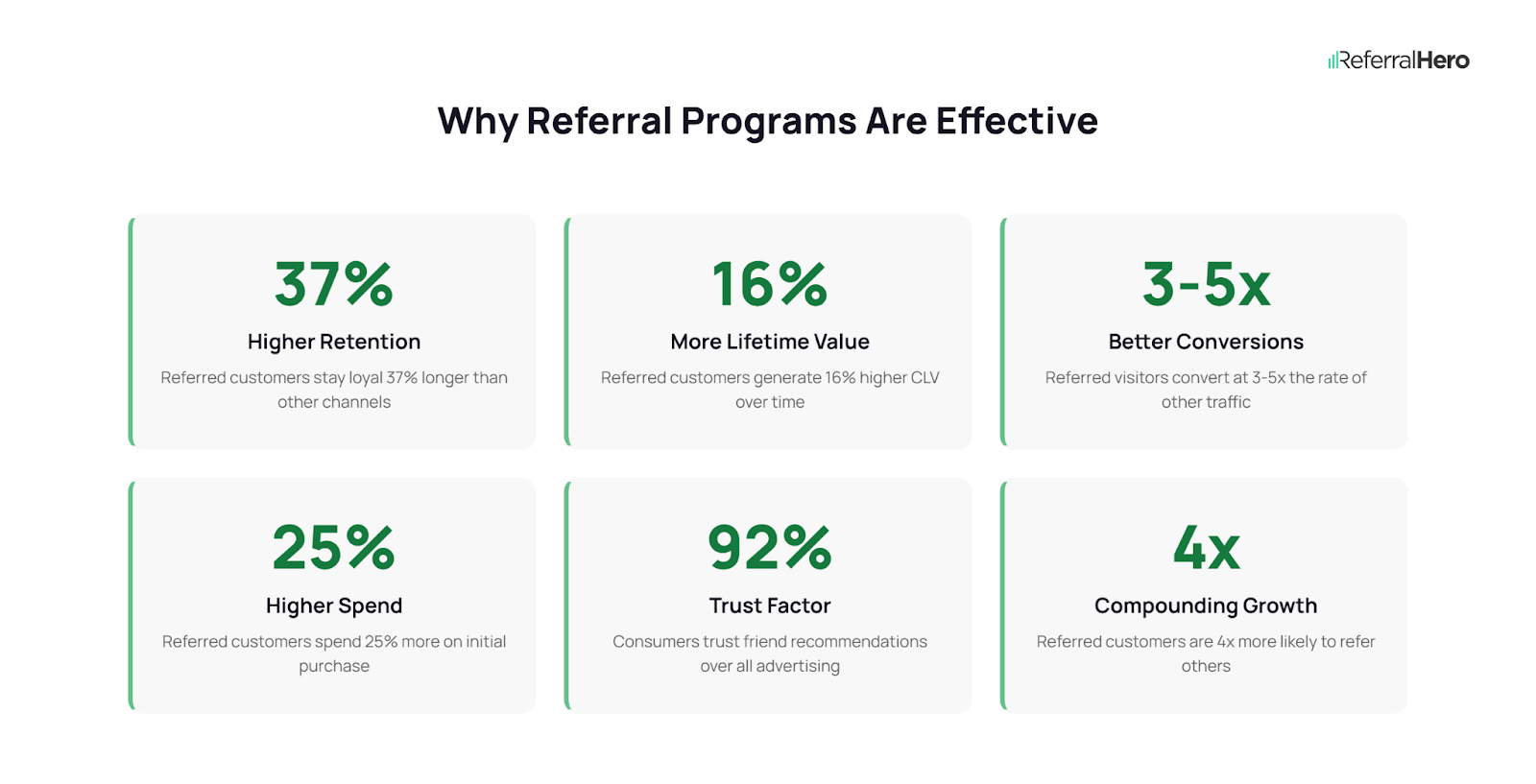
Higher Customer Lifetime Value - Referred customers have a 16% higher lifetime value compared to non-referred customers (Wharton School of Business) - They make repeat purchases more frequently and at higher values - Over a six-year period, referred customers show 60% higher ROI
Superior Retention Rates - Referred customers have a 37% higher retention rate (Nielsen) - They’re 18% more loyal than customers acquired through other channels - This dramatically reduces churn and increases long-term profitability
Drastically Lower Acquisition Costs - Customer acquisition costs drop by 13-35% when implementing referral marketing effectively (Deloitte/Forrester) - The average cost to acquire a referred customer is $23.12 less than non-referred customers - With customer acquisition costs increasing by 29% in 2024 (Gartner), this efficiency matters more than ever
Faster Conversion - Referred visitors convert at 3-5x the rate of other traffic sources - They require less convincing because trust is pre-established - Sales cycles in B2B settings close 69% faster with referrals
Expanded Brand Awareness - Referred customers are 4x more likely to refer others, creating a compounding growth effect (Harvard Business Review) - Word-of-mouth recommendations drive 2-3x more sales than paid advertising (McKinsey) - This creates organic reach that traditional marketing can’t match
What Customers Get Out of It
It’s not just businesses that benefit. Referred customers and referrers both win:
For the Person Making Referrals: - Valuable rewards (discounts, cash, free products, exclusive perks) - Satisfaction of helping friends discover solutions - Recognition and status within brand communities - Feeling of being valued by companies they support
For the New Customer: - A trusted recommendation reducing purchase anxiety - Often receives their own welcome reward - Higher confidence in their purchase decision
This mutual benefit is why 83% of consumers say they’re willing to refer brands they love—though only 29% actually do so without structured encouragement. That gap represents massive untapped potential.
Curious about specific examples of these benefits in action? Our referral program examples post showcases real companies crushing it with referrals.
Types of Referral Programs
Not all referral programs look alike. The structure you choose depends on your business model, industry, and goals.
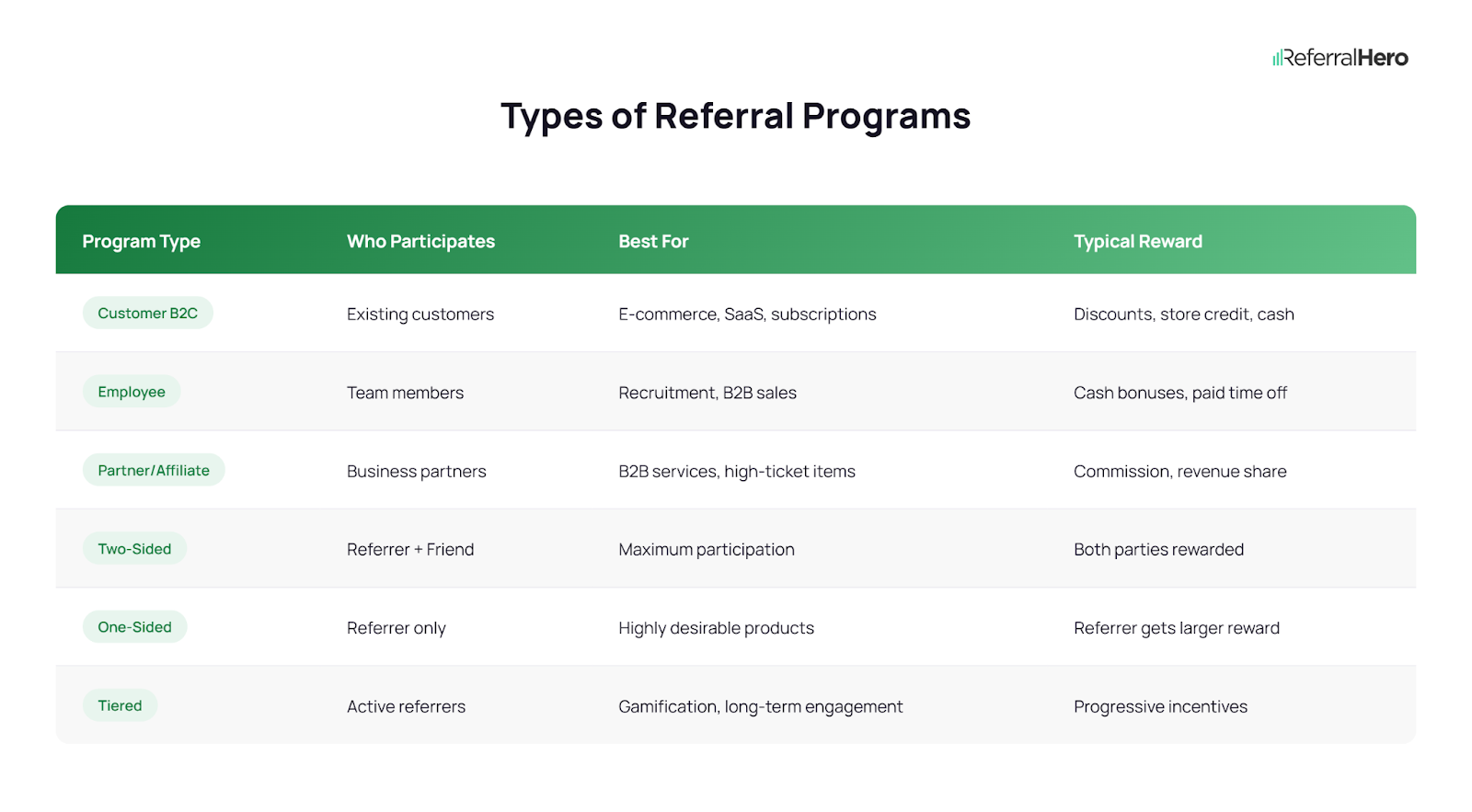
By Participant Type
1. Customer Referral Programs (B2C and B2B)
The most common type. Your existing customers refer friends, family, or colleagues to your business.
- Best for: E-commerce, SaaS, services, subscriptions
- Example structure: Customer gets $20 credit, friend gets 15% off first purchase
- Why it works: Customers already love your product and have built-in networks to tap
2. Employee Referral Programs
Your team members recommend candidates for open positions or refer the company’s products to their personal networks.
- Best for: Recruitment, B2B sales, service businesses
- Example structure: Employee receives $1,000 bonus if their candidate is hired and stays 90 days
- Why it works: Employees know your culture and can identify good fits; referred candidates are hired 15x more often
3. Partner/Affiliate Referral Programs
Other businesses or individuals refer clients to you, often in complementary industries.
- Best for: B2B services, professional services, high-ticket items
- Example structure: Marketing agency refers clients to web developer; developer pays 10% commission
- Why it works: Creates mutually beneficial relationships and taps into established professional networks
By Reward Structure
1. One-Sided Rewards
Only the person making the referral receives a reward. The new customer doesn’t get an incentive.
- When to use: When your product is highly desirable on its own or when you want to maximize referrer motivation
- Pros: Simpler to manage, can offer larger rewards to referrers
- Cons: Less appealing to the referred friend, potentially lower conversion rates
2. Two-Sided Rewards
Both the referrer and the new customer receive rewards—this is the most popular approach.
- When to use: When you want maximum participation and conversion
- Pros: Creates win-win scenario, motivates sharing AND signup, 65% of referrers prefer this structure
- Cons: Higher cost per acquisition
3. Tiered Rewards
Progressive incentives that increase based on the number of successful referrals made.
- When to use: When you want to encourage ongoing participation
- Example: 1-3 referrals = $10 each, 4-10 referrals = $15 each, 11+ referrals = $25 each
- Pros: Gamifies the experience, rewards your most valuable advocates more generously
- Cons: More complex to communicate and manage
By Industry Application
Different industries have developed referral approaches optimized for their specific dynamics:
E-commerce Referrals - Often feature discount codes or store credit - Visual products make social sharing more engaging - Quick purchase cycles allow for faster reward delivery
SaaS Referrals - Typically offer extended free trials or upgraded features - May have longer sales cycles requiring multiple touchpoints - Focus on professional networks and LinkedIn sharing
Service-Based Referrals - Often use cash rewards or significant discounts - Trust factor is amplified given intangible nature - Local businesses particularly benefit from community networks
Subscription Referrals - Reward with free months or perpetual discounts - Create ongoing value that compounds over time - Churn reduction is a major benefit
Understanding different referral reward structures helps you choose the right incentives for your audience.
What Makes a Referral Program Successful?
I’ve analyzed hundreds of referral programs, and the successful ones share common characteristics. Here’s what separates programs that flourish from those that flop.
1. Crystal-Clear Value Proposition
Your customers should understand in seconds: - What they’ll get for referring - What their friend will receive - Exactly what action triggers the reward
Confusion kills participation. If someone has to read three paragraphs to understand your program, they won’t bother.
Poor example: “Refer friends and unlock exclusive rewards based on their activity levels!” Strong example: “Refer a friend → They get 20% off → You get $25 credit. Simple.”
2. Genuine Simplicity
The best referral programs have virtually zero friction:
- Joining takes one click
- Sharing requires minimal effort (pre-written messages, one-click social buttons)
- Tracking progress is transparent and easy
- Rewards arrive automatically
Every additional step you add cuts participation rates. Ruthlessly eliminate unnecessary complexity.
3. Strategic Promotion
Even the best referral program fails if nobody knows about it. Successful programs promote across multiple touchpoints:
- Email campaigns to existing customers (especially post-purchase when satisfaction is high)
- In-app notifications for software products
- Website placement on homepage, account pages, and checkout
- Social media to create buzz and remind people regularly
- Customer support training reps to mention it during positive interactions
The most successful programs promote consistently, not just at launch.
4. Robust Tracking System
Nothing torpedoes trust faster than rewards that don’t arrive or referrals that don’t get credited properly.
Your tracking needs to: - Accurately attribute every referral to the right person - Show participants their progress in real-time - Deliver rewards automatically and promptly - Provide transparency throughout the process
This is why dedicated referral software almost always outperforms manual tracking.
5. Compelling Rewards
The reward needs to be meaningful enough to motivate action, but sustainable for your business.
Key considerations: - Match your audience: Gen Z and Millennials often prefer cash or gift cards; loyal customers may value exclusive perks - Proportional to effort: The reward should feel worth the act of reaching out to friends - Aligned with your margins: Ensure the economics work long-term - Delivered promptly: Delayed rewards kill enthusiasm
Research shows that while rewards typically average around $10, consumers expect $21-40 for participation. Finding the right balance is crucial.
6. Product-Market Fit Foundation
Here’s the uncomfortable truth: no referral program can save a mediocre product.
Successful referral programs are built on a foundation of genuine customer satisfaction. People only enthusiastically recommend things they truly believe in.
If your Net Promoter Score is low, or customer satisfaction is shaky, fix that first. A referral program amplifies existing sentiment—both positive and negative.
Common Pitfalls to Avoid
Even well-intentioned programs stumble. Watch out for these mistakes:
- Overly complicated terms and conditions that discourage participation
- Rewards that take weeks to arrive killing momentum and trust
- Poor communication leaving participants confused about program status
- Inadequate promotion resulting in low awareness
- Wrong reward choice that doesn’t resonate with your audience
- No mobile optimization when most sharing happens on phones
- Ignoring fraud prevention leading to abuse and budget drain
Key Metrics to Track
You can’t improve what you don’t measure. Monitor these KPIs:
- Participation rate: What percentage of customers join your program?
- Share rate: How many participants actually share their link?
- Conversion rate: What percentage of referred visitors take action?
- Viral coefficient: How many new customers does each existing customer generate?
- Program ROI: Revenue generated vs. costs (rewards + software + management)
- Referral velocity: How quickly are referrals generating new referrals?
Data reveals where your program shines and where it needs optimization.
Do Referral Programs Work for Every Type of Business?
Short answer: Most businesses can benefit, but the approach varies significantly.
Let me break down when referral programs make the most sense, and when you might want to wait or take a different approach.
Businesses That Thrive with Referral Programs
Referral programs deliver the strongest results when you have:
1. High Customer Satisfaction If your Net Promoter Score is strong and customers genuinely love what you offer, they’re primed to refer. The best referral programs don’t create advocacy—they channel existing enthusiasm.
2. Repeatable Purchase Patterns Whether it’s subscription renewals, recurring services, or products people buy multiple times, repeat customers have more opportunities to refer over time.
3. Clear Value Proposition If explaining what you do requires a 20-minute presentation, referrals become harder. Products or services with immediately understandable benefits spread more naturally.
4. Network Effects Businesses where the product becomes more valuable as more people use it (like social platforms, communication tools, or marketplaces) benefit enormously from referral growth.
5. Reasonable Price Points Extremely low-ticket items may not justify the reward economics, while extremely high-ticket items may require more than a simple referral for closing. That said, both can work with the right structure.
Industry-Specific Considerations
E-commerce - Sweet spot: Product quality must be excellent; visual products do especially well - Strategy: Use discount codes, make social sharing of products easy, leverage unboxing moments - Timing: Promote immediately post-purchase when excitement is highest
SaaS & Technology - Sweet spot: Complex sales cycles benefit from trusted referrals breaking through noise - Strategy: Offer extended trials or feature upgrades, focus on professional networks - Timing: Target satisfied users after they’ve experienced clear value (30+ days in)
Service Businesses - Sweet spot: Trust is paramount; recommendations carry enormous weight - Strategy: Cash rewards often work better than service discounts, local targeting matters - Timing: Ask immediately after delivering exceptional service while satisfaction is peak
B2B Companies - Sweet spot: 84% of B2B decisions start with a referral; this is your domain - Strategy: Higher-value rewards, longer sales cycles, focus on LinkedIn and professional events - Timing: After demonstrable ROI and strong relationship establishment
For small businesses specifically, referral programs can be incredibly powerful with limited resources. Our small business referral guide shows how to get started without a massive budget.
When to Wait or Reconsider
Referral programs might not be right if:
Product-Market Fit Isn’t Established If you’re still figuring out your core offering and iterating frequently, hold off. Nail your product first, then amplify it through referrals.
High Churn Rates If customers are leaving quickly, a referral program will just accelerate a leaky bucket. Fix retention before focusing on acquisition.
Poor Customer Satisfaction Low NPS scores or negative reviews indicate you need to improve the core experience before asking for referrals.
Limited Operational Capacity Referral programs can work TOO well. If you can’t handle an influx of new customers without service quality suffering, scale your operations first.
Extremely Long Sales Cycles For products requiring 18+ month sales cycles, traditional referral programs may need heavy modification. Partner programs or more complex B2B referral structures often work better.
The Universal Truth
Here’s what I’ve learned: almost any business CAN have a referral program, but the structure, timing, and expectations need to match your specific reality.
A coffee shop’s referral program looks nothing like a law firm’s. An app’s program works differently than a consulting firm’s. The core principle—rewarding happy customers for spreading the word—remains constant, but execution varies wildly.
Key Components of Modern Referral Programs
Let’s get practical. What does a well-functioning referral program actually consist of?
Technology Stack
Referral Software Platform: Dedicated tools like ReferralHero handle the heavy lifting: generating unique links, tracking attribution, managing rewards, and providing analytics. Trying to build this in-house or manage manually rarely ends well.
CRM Integration: Your referral program should connect with your customer database to know who’s eligible, track customer lifecycle stage, and personalize communications.
Marketing Automation Connection: Automated emails triggered by program milestones (signup, first referral, reward earned) keep participants engaged without manual effort.
Analytics Tools: Deep visibility into program performance lets you optimize continually. Look for platforms offering dashboards, cohort analysis, and A/B testing capabilities.
Communication Elements
Landing Page: A dedicated page explaining your program, showing rewards, and making signup dead simple. This becomes your central referral hub.
Email Templates: Automated emails for different scenarios: invitation to join, successful referral notification, reward delivery confirmation, monthly progress updates.
Social Sharing Assets: Pre-written posts for Facebook, Twitter, LinkedIn, and Instagram. Many platforms generate these automatically.
In-App Notifications: For software products, contextual prompts that appear when satisfaction is likely high.
Legal and Compliance
Terms and Conditions: Clear rules about eligibility, reward fulfillment, prohibited behaviors, and program modifications.
Privacy Considerations: Transparency about how referral data gets used, stored, and protected. GDPR and CCPA compliance where applicable.
Fraud Prevention Policies: Guidelines on self-referrals, multiple accounts, and other abusive behaviors—plus consequences for violations.
Support Infrastructure
FAQ Resources: Anticipate common questions: How do I share? When do I get my reward? What if my friend doesn’t use my link?
Customer Service Training: Your support team needs to handle referral-related inquiries confidently and consistently.
Troubleshooting Systems: Process for investigating disputed referrals or tracking issues.
All of these components work together to create a smooth experience that builds trust and encourages participation. Choosing the right referral software can make setup and management significantly easier.
Getting Started with Your Referral Program
You’re convinced referral programs work. Now what?
Readiness Checklist
Before launching, make sure you have:
✓ Strong product-market fit – Customers should already be naturally recommending you
✓ Solid customer satisfaction – Aim for NPS of 30+ minimum
✓ Clear understanding of customer lifecycle – Know when satisfaction peaks
✓ Budget allocated – For rewards and software
✓ Resources committed – Someone owns program success
✓ Technical capability – Can implement tracking and automation
Quick-Start Process
1. Define Your Goals: What does success look like? More customers? Lower acquisition costs? Higher lifetime value? Specific, measurable goals shape everything else.
2. Choose Your Reward Structure: Start with what’s sustainable long-term. You can always increase rewards, but decreasing them kills trust.
3. Select Your Technology: Dedicated referral software pays for itself quickly through automation and fraud prevention. Don’t try to hack together spreadsheets.
4. Plan Your Promotion Strategy: Map out where, when, and how you’ll tell customers about the program. Multiple touchpoints beat one-time announcements.
5. Launch Small and Learn: Consider a beta launch with your most engaged customers. Gather feedback, fix issues, then scale to your full base.
Your Next Steps
Ready to build your own referral program? Here are resources to help you get started:
- Learn about referral codes and how they work
- Discover referral program templates you can copy
- Get inspired by real referral program examples
- Understand referral systems and tracking
- Explore referral partner programs for B2B growth
Timeline Expectations
Setting realistic expectations helps:
Weeks 1-2: Setup and Testing Configure software, design rewards, create promotional materials, test with small group.
Month 1: Launch and Initial Promotion Roll out to full customer base, promote across channels, monitor early performance.
Months 2-3: Optimization Analyze data, adjust messaging, tweak rewards if needed, identify and solve friction points.
Month 4+: Scaling and Integration Incorporate referral promotion into standard customer journey, expand to new segments, refine based on long-term trends.
Many programs see initial traction within weeks but hit their stride after 2-3 months of optimization.
Frequently Asked Questions
How much does it cost to run a referral program?
The cost breaks into three categories:
Software: Referral platforms typically range from $50-$500+ per month depending on features and scale. Many offer free tiers for small businesses, however, what you pay for is what you get applies here.
Rewards: This is your variable cost. Budget based on expected referral volume and reward values. Start with what’s sustainable long-term.
Management: Time spent on setup, promotion, optimization. Initially higher, then becomes minimal with automation.
Most businesses find the ROI justifies costs within the first few months, especially given that referral-acquired customers have 16% higher lifetime value.
How long does it take to see results?
Typical timeline: - Week 1-2: Initial referrals trickle in as early adopters participate - Month 1: Momentum builds as promotion reaches full customer base - Month 2-3: Program hits stride with consistent referral flow - Month 4+: Compounding effects kick in as referred customers become referrers
That said, some businesses see immediate traction while others take longer depending on product type, customer engagement, and promotional effectiveness.
What’s the best reward for a referral program?
The “best” reward depends on your audience and margins. Research shows:
- Cash and gift cards: Most universally appealing (54% of consumers prefer this)
- Discounts: Work well for products with repeat purchases
- Free products/services: Strong for consumables or subscriptions
- Exclusive perks: Effective for premium brands or when scarcity adds value
Test different options and let data guide you. The optimal reward balances customer motivation with sustainable economics for your business.
Can small businesses run referral programs?
Absolutely—and they should. Small businesses often benefit even more than large companies because:
- Tighter customer relationships create more enthusiastic advocates
- Community-focused businesses naturally thrive on word-of-mouth
- Lower marketing budgets make cost-effective referral acquisition especially valuable
- Local networks are powerful for service-based and brick-and-mortar businesses
Modern referral software has made programs accessible and affordable for businesses of all sizes.
How do I prevent referral fraud?
Quality referral software includes built-in fraud detection:
- Duplicate account monitoring catches self-referrals or fake accounts
- IP address tracking identifies suspicious patterns
- Email verification ensures referrals are real people
- Behavioral analysis flags unusual referral velocity or patterns
- Manual review processes for high-value rewards
Set clear terms prohibiting fraudulent activity and enforce consequences. Most fraud attempts are obvious and easily blocked by modern systems.
What’s a good referral rate?
Benchmarks vary by industry, but general guidelines:
- Participation rate: 5-10% of customers joining your program is solid
- Share rate: 40-50% of enrolled members actually sharing
- Conversion rate: 2-5% of referred visitors taking action is typical
- Viral coefficient: Above 1.0 means each customer generates more than one new customer (exponential growth)
That said, focus less on industry averages and more on improving your own baseline over time.
Should I offer one-sided or two-sided rewards?
Research shows 65% of referrers prefer two-sided programs where both parties get rewarded. These typically drive: - Higher participation rates - Better conversion rates - More satisfied referred customers
However, one-sided programs work well when: - Your product is highly desirable without additional incentive - You want to maximize referrer rewards within budget - Simplicity is paramount
Many successful programs start one-sided and evolve to two-sided as they scale.
How do I promote my referral program?
Most effective promotion channels:
Email campaigns: Regular reminders plus milestone-triggered emails
Post-purchase moments: When satisfaction is highest
In-app notifications: For software products during positive interactions
Website placement: Account dashboard, homepage footer, checkout confirmation
Social media: Regular posts showcasing top referrers and rewards
Customer support: Trained reps mentioning program during positive calls
The key is consistent, multi-channel promotion. One announcement isn’t enough—make your program visible throughout the customer journey.
The Bottom Line
Referral programs aren’t just another marketing tactic—they’re a fundamental shift in how businesses grow. By systematically rewarding happy customers for spreading the word, you’re building a growth engine powered by your most valuable asset: genuine customer satisfaction.
The data doesn’t lie: referred customers cost less to acquire, spend more, stay longer, and refer others. In an era when trust in traditional advertising continues to plummet and acquisition costs keep climbing, referral programs represent one of the most efficient paths to sustainable growth.
But here’s what matters most: referral programs aren’t about gaming the system or manipulating people. They’re about creating such a remarkable experience that customers genuinely want to share it—and then making that sharing as easy and rewarding as possible.
Whether you’re running a small local service business or scaling a tech company, the core principle applies. Start with a product people love, build a program that respects their effort, promote it consistently, and watch your customers become your most effective growth channel.
The question isn’t whether referral programs work—the evidence is overwhelming. The question is: what could yours look like?
Ready to turn your customers into advocates and advocates into revenue? Start your free ReferralHero trial or book a demo to see how we’ve helped thousands of businesses build referral programs that actually grow their bottom line.
Your customers are already talking about you. Let’s make sure they’re rewarded for it.

